
The Sacred Pause: Why We Rest Before We Rise (A New Year’s Alternative)

Winter’s Wisdom (to chill out)
The Context: Winter’s Wisdom vs. Societal Haste
As we cross from December into January, the collective consciousness buzzes with the energy of "fixing." We are bombarded with messages to detox, sprint, and reinvent ourselves. Yet, if we look outside, Nature—our greatest teacher—is doing the opposite. The sap is deep in the roots; the animals are quiet.
In SVA Ayurveda, we are in the junction of late Hemanta and early Shishira (deep winter). The atmosphere is heavy, cold, and dry. If we meet this season with frantic activity and heating "detoxes," we risk burning out our adrenals and aggravating Ranjaka Pitta (the liver’s fire), which is likely already sensitive from holiday sugar and stress.
The Reframing
Instead of a "New Year, New Me," let us embrace a "New Year, Deep Rest." You cannot pour from an empty cup, and you cannot build a sustainable future on a nervous system running on fumes.
The Synthesis: Ancient Sutras meet Modern Science
The Science: The Dopamine Trap
Modern neuroscience, championed by experts like Dr. Andrew Huberman, teaches us about "Reward Prediction Error." When we set massive, unattainable resolutions in January, we spike our dopamine. When we inevitably struggle to maintain that intensity, dopamine crashes below baseline, leading to lack of motivation and low mood. Furthermore, attempting to change habits while the autonomic nervous system is in "fight or flight" (sympathetic dominance) is biologically expensive and rarely lasts.
The Sutra: Sankalpa vs. Vikalpa
The Vedas offer a different path: Sankalpa. Unlike a resolution (which often stems from a feeling of lack—"I am not enough"), a Sankalpa is a vow born from your highest truth. It whispers, "I am already whole."
Advaita (Non-duality): You are not a broken thing that needs fixing. You are consciousness experiencing a human life.
The Bridge: By resting now (in January), we move our nervous system into a parasympathetic state (Rest and Digest). Only from this state of safety can neuroplasticity occur effectively. We rest now so we can evolve later.
Actionable Tools: Fill Your Cup
1. SVA Recipe: The "Soma-Restoring" Spiced Night Milk
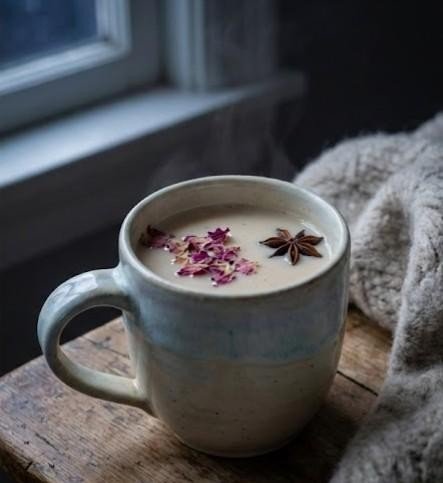
The "Soma-Restoring" Spiced Night Milk
Ayurvedic Logic: In January, many reach for "Master Cleanses" with lemon and cayenne. Stop. For the modern physiology dealing with Garavisha (environmental toxins) and EMF exposure, the liver is often already hot and reactive. We need Soma (cooling, nurturing energy), not more heat.
Ingredients:
1 cup high-quality organic A2 cow’s milk (or almond milk for vegans).
1 pinch of SVA "Mum’s Masala" or a mix of: 2 parts Fennel, 2 parts Coriander, 1 part Turmeric.
1/2 tsp Rose Petal preserve (or dried culinary rose petals).
1 crushed pod of Cardamom.
Optional: A strand of saffron (to cheer the heart).
Method:
Simmer the spices in the milk for 3–5 minutes. Pour into your favorite mug. Sip slowly before bed to lubricate the channels (Shrotas) and calm the mind (Prana Vata).
Safety Note:
Dairy: If you have a mucus cough or heavy congestion (Kapha imbalance), skip the dairy and the rose petals, use water or almond milk.
Turmeric: Use cautiously if you are on blood thinners or pregnant (consult your physician).
Liver Safety: We specifically use Fennel and Coriander here because they aid digestion without heating the liver, unlike dry ginger or cayenne.
2. Somatic Movement: The "Constructive Rest" Position

The "Constructive Rest" Position
Why: This releases the psoas muscle (the "muscle of the soul"), which holds trauma and fight-or-flight tension.
The Practice:
Lie on your back on a warm rug or mat.
Bend your knees, keeping feet flat on the floor, about hip-width apart.
Let your knees knock together gently so your legs support themselves (zero effort).
Place your hands on your belly.
Stay here for 10 minutes. Feel the earth holding you. You do not need to "do" anything.
Safety Note for Back Pain: If this strains your lower back, place a bolster or pillow under your knees.
3. IFS Meditation: Meeting the "Taskmaster"
Close your eyes. Notice the part of you that is yelling, "We need to get fit! We need to work harder!"
Instead of obeying it or fighting it, simply ask: "What are you afraid will happen if we rest?"
Usually, this part is afraid you will be unworthy. Send that part compassion. Let it know: "We are safe to slow down."
Eco-Therapy: The Dormancy Walk
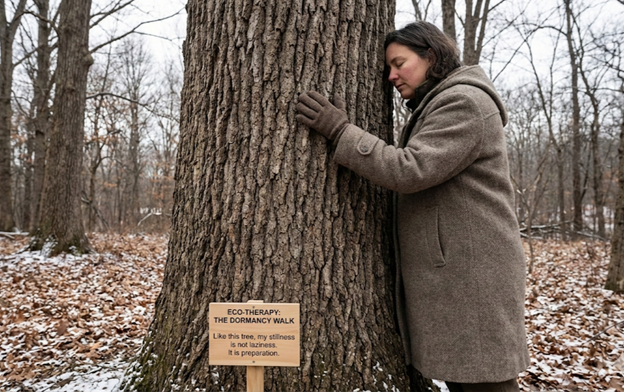
Eco-Therapy
Go outside. Find a tree that has lost its leaves.
Observe it. Is the tree "dead"? No. It is doing its most important work underground. It is gathering resources.
Touch the bark. Remind yourself: Like this tree, my stillness is not laziness. It is preparation.
Closing Thought
The seed does not struggle to become the flower. It waits for the light, it drinks the rain, and it unfolds.
This January, be the seed. The bloom will come in its own time.