
The Dharma of Dialogue: A Vedic Approach to Navigating Conflict
Earlier this month, we explored the profound connection between gut health, the microbiome, and mental well-being—a powerful reminder that our internal physical landscape dictates so much of our mental clarity. But what happens when the disturbance comes from the outside? What happens when our relationships, workplaces, or daily interactions challenge our hard-won peace?
For many of us, conflict triggers an immediate nervous system response. We either want to fight back to prove a point, or we want to retreat and avoid the discomfort altogether. But in the traditions of Vedanta (vay-DAHN-tuh) and Yoga, conflict isn't just an obstacle; it is a profound opportunity to practice Dharma (DHAR-muh - right action) and deepen our understanding of ourselves.
Rather than just "fixing" a disagreement, the Vedic standpoint focuses on restoring universal order and recognizing the underlying unity between all of us. Here is how we can apply these ancient principles to navigate modern friction.
The Internal Compass: The Gunas and Viveka
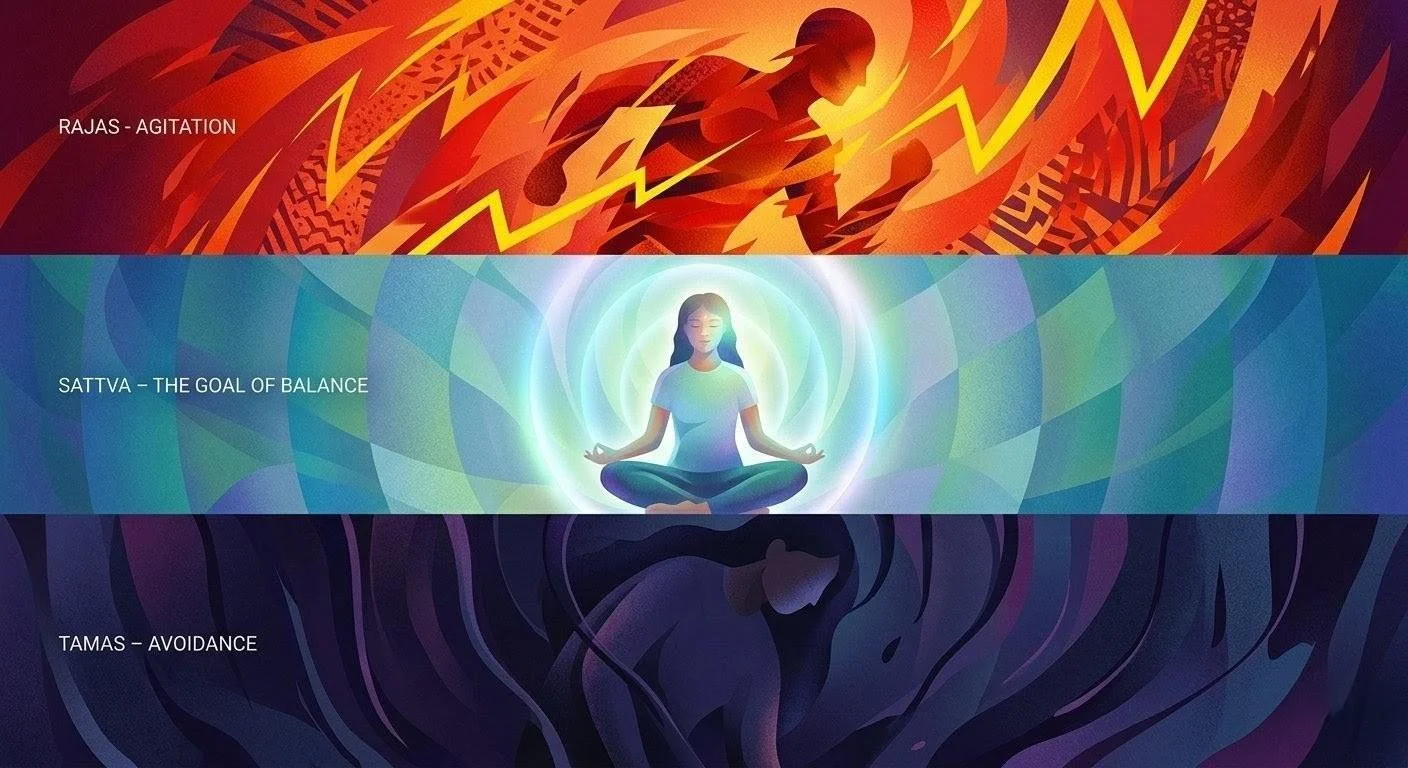
Our internal forces
Before we can resolve a conflict with someone else, we have to examine our own internal state. Conflict is almost always fueled by an imbalance in the Gunas (GOO-nuhs - the fundamental forces of nature):
Rajas (RAH-juhs - Agitation): The aggressive, ego-driven desire to "win" or be right. In a somatic sense, this is our fight-or-flight response.
Tamas (TAH-muhs - Avoidance): The heavy, lethargic urge to ignore the problem, sweep it under the rug, or shut down (the freeze response).
To resolve conflict, we must consciously shift our nervous system into Sattva (SAHT-vuh) (purity, light, and balance). We do this by applying Viveka (vih-VAY-kuh)—the sword of discernment.

Applying viveka discernment
In the heat of the moment, pause and ask yourself: "Is my ego offended right now, or is a genuine boundary being crossed?" When we detach our ego from the outcome, we stop reacting emotionally and start responding with clarity.
The Five Filters of Speech (Vachika Tapas)
In the Vedic tradition, words are sacred. They carry energetic weight (Spanda - SPUHN-duh) and create ripple effects in our lives. Before speaking during a tense situation, try running your words through these five gates of "austerity of speech":
🗣️ Satyam (SUHT-yum - Is it True?): Are you speaking to the objective facts, or are you speaking from your own emotional interpretation?
🗣️ Priyam (PREE-yum - Is it Kind?): Can this truth be delivered without a sharp edge?
🗣️ Hitam (HIH-tum - Is it Beneficial?): Does saying this actually move the situation toward a resolution, or does it just vent your frustration?
🗣️ Anudvegakaram (uh-nood-vay-guh-KAH-rum - Is it Non-Agitating?): Will this phrasing cause the other person to immediately raise their defensive walls?
🗣️ Svadhyaya (svahd-YAH-yuh - Is it Mine?): This is the filter of self-study. Ask yourself: "Am I projecting a past wound or trauma onto this person in the present moment?"
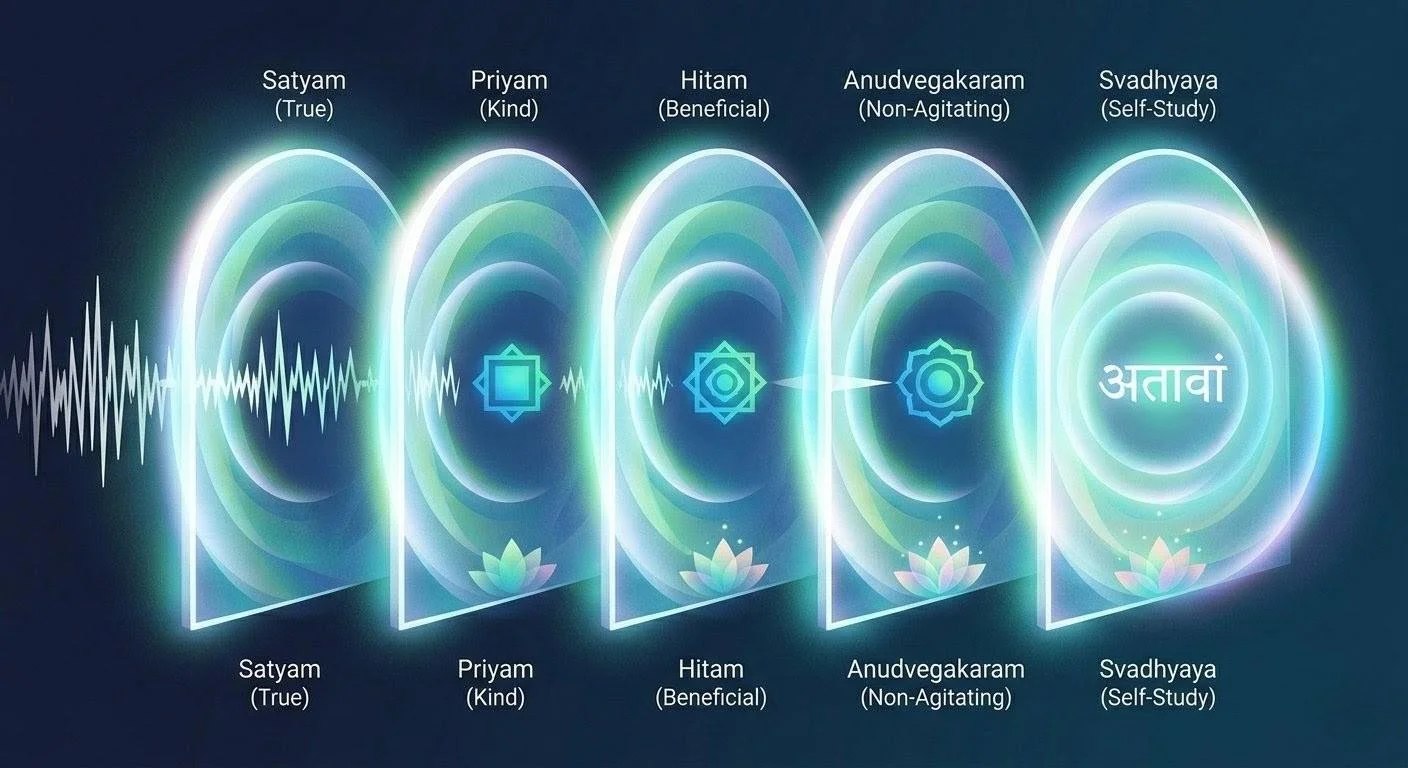
The sequence of refining speech
The Four Upayas: A Strategy for Resolution
When we are grounded in Sattva (SAHT-vuh) and mindful of our speech, we can apply the four Upayas (oo-PAH-yuhs)—the traditional Vedic strategies for dealing with friction. These are progressive steps; you start at the top and only move down if the previous step fails.
👂Sama (SAH-muh - Conciliation): This is the path of dialogue. It involves active listening, finding common ground, and asking, "How can we both serve the higher purpose here?"
🎁Dana (DAH-nuh - Concession): Sometimes, peace requires a small sacrifice. Dana is the willingness to let go of a preference, a point of pride, or a minor detail to ensure the relationship or project succeeds. It is the art of giving to get.
🧠Bheda (BHAY-duh - Logic and Analysis): If emotions are running too high for gentle conciliation, we use clear, compassionate logic. This involves pointing out the natural consequences of continuing the conflict. "If we continue this way, neither of us will reach our goal."
🫸Danda (DUHN-duh - Firmness and Boundaries): Used only as a last resort, this is the setting of a hard boundary. It is not about punishment; it is about protecting your energy and upholding Dharma (DHAR-muh). "For the health of this relationship, I cannot allow this behavior to continue."
🙏Closing the Karma (KAR-muh)
A conflict is only truly resolved when the energetic debt is cleared. If you win an argument but destroy the relationship or compromise your integrity, you have not found a Vedic resolution.
As we move through our daily lives, remember that the goal isn't the absence of disagreements, but the presence of harmony. True peace comes when we can view the "other" not as an opponent, but as a different expression of the exact same consciousness.