
The Anchor: How to Tame the "Monkey Mind" with Sound
Why silence is too loud for a busy brain, and the ancient technology of Mantra.
The Hook: The Monkey and the Pole
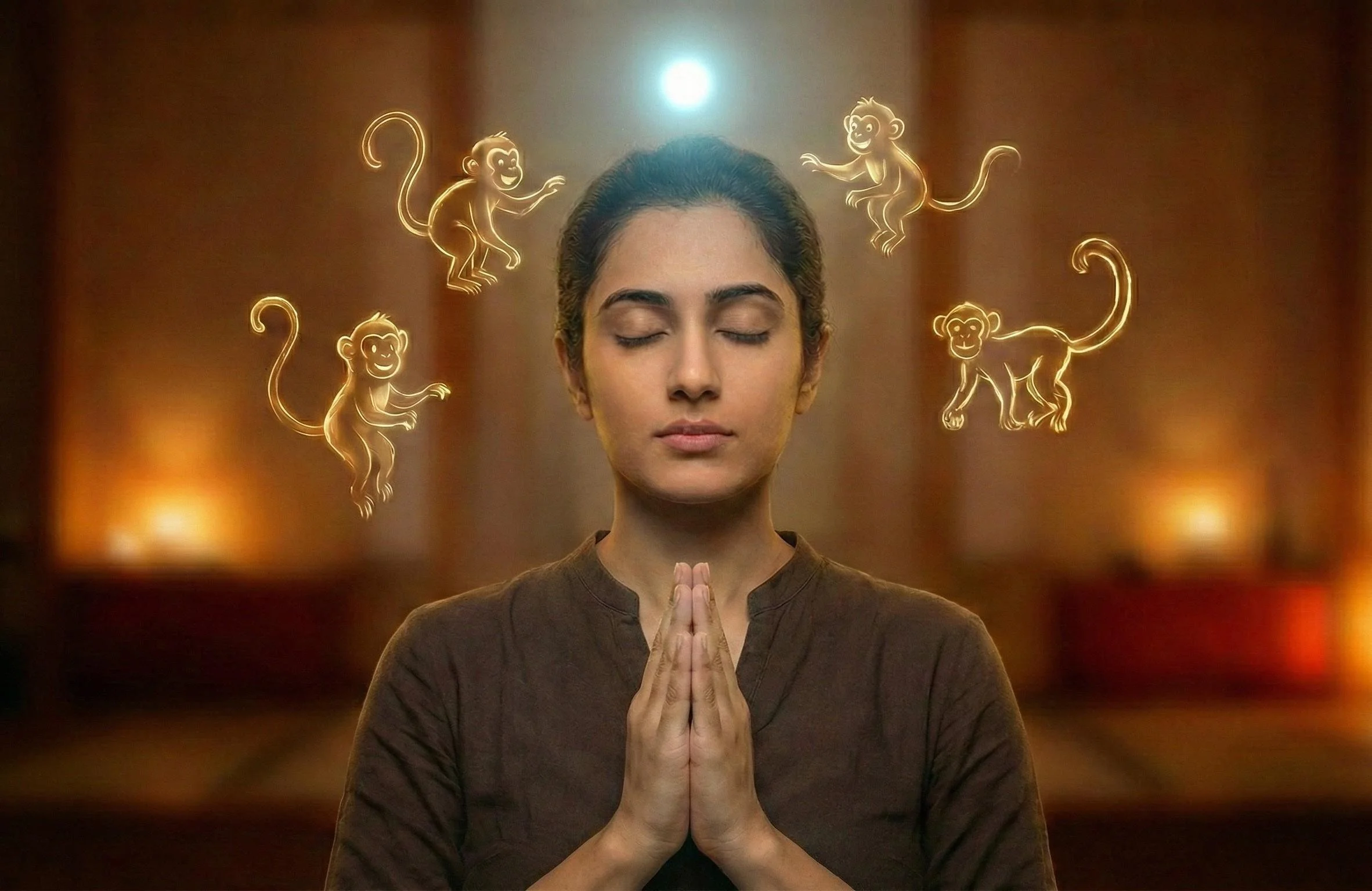
If you scored "Mostly A’s" on last week’s quiz, your mind is likely fast, creative, and perhaps a little anxious. When you try to sit in silence, your brain doesn't slow down; it speeds up.
In the Yoga tradition, we call this the "Monkey Mind" (Kapicitta). The monkey is drunk on scorpion venom and jumping from tree to tree. If you try to wrestle the monkey (force your mind to stop), it only fights harder.
So, what do we do? We don't fight the monkey. We give the monkey a job.
We give it a Mantra.
2. The Synthesis: The Sage & The Scientist
The Scientist: The "Phonetic Loop"
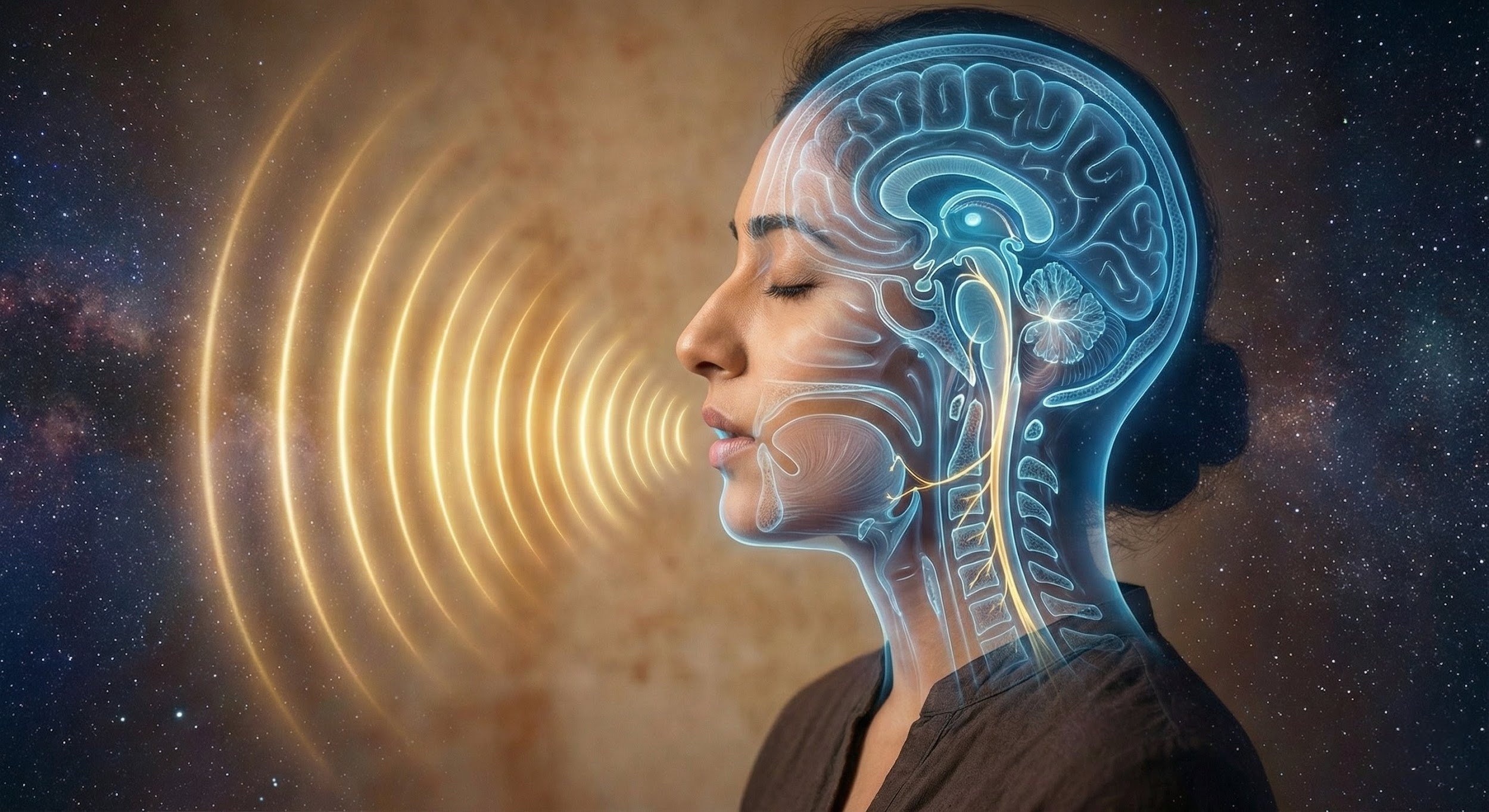
Why does repeating a word work? Cognitive science calls this the "Phonetic Loop." Your brain has a limited amount of bandwidth for language. If you are actively repeating a sound (mantra), your brain literally does not have the bandwidth to simultaneously narrate your worries about tomorrow's meeting. You are "jamming" the signal of the Default Mode Network with a higher frequency.
Furthermore, the physical vibration of humming or chanting stimulates the Vagus Nerve (which passes through the vocal cords), sending a direct signal to your body to down-regulate from stress.
The Sage: Mind Protection
The word Mantra comes from two Sanskrit roots: Man (mind) and Tra (vehicle or protection). A mantra is an instrument that transports and protects the mind.
The Sages taught that the universe is made of sound (Naada Brahma). When we chant, we aren't just making noise; we are tuning our personal instrument to a frequency of peace, bypassing the intellect entirely to soothe the soul.
3. The Tool: Japa Meditation (The Mala)

The most tangible way to practice this is Japa—the recitation of mantra using a string of beads called a Mala.
The Hardware: A Mala has 108 beads plus one "Guru Bead."
The Software: You hold the mala in your right hand, draped over the middle finger (Saturn finger/discipline). You use your thumb (Mars/ego) to pull the beads toward you, one by one, reciting your mantra on each bead.
The Result: This engages the sense of touch (the beads), speech (the chant), and hearing (the sound). The Monkey Mind is so busy with all these tasks, it forgets to worry!
4. The Practice: "So-Hum" (I Am That)

For beginners, I recommend the universal mantra: So Hum.
It is safe, tridoshic (balances all body types), and requires no initiation. It simply means "I am That" (I am one with the Universe).
Find your seat. Spine straight, eyes closed.
Inhale silently through the nose, and mentally hear the sound "Sooooo."
Exhale silently (or softly audibly), and hear the sound "Hummmm."
Repeat. If you have beads, move one bead for every full breath cycle.
The Return: When you catch yourself thinking about dinner (and you will), gently say, "Not now," and come back to "So... Hum."
5. Safety & Contraindications Protocol
Pitta (Heat) Warning: If you are feeling angry, frustrated, or physically hot (hot flashes/rashes), avoid loud, vigorous chanting or "Solar" mantras (like Om Namo Bhagavate...). Stick to a soft, mental whisper of So-Hum.
The Throat: If your voice feels strained, switch to "Manasika Japa" (Mental Chanting). This is actually considered the most powerful form because it requires more focus!
6. Your Homework: 108 Breaths
This week, try to complete one round of a Mala (or roughly 7–10 minutes).
Use "So Hum."
Notice: Does having a "job" to do make the silence less scary?
Preview for Next Week
Tease: "But what if you aren't a busy thinker? What if you are a deep feeler who gets overwhelmed by emotions? Next week, we speak to the 'Witness' archetype—and how to meditate when the body feels too heavy to hold."