
🌿 The Breath That Breaks the Craving:
What New Research Reveals About Pranayama and Addiction Recovery
There is a moment, familiar to anyone who has ever craved something they were trying to release, when the whole body seems to lean toward the thing it wants. The mind races ahead. The breath grows shallow and fast. And in that narrow window, before the craving either passes or wins, something as simple as breath can change the outcome.
A new study gives us real evidence for what Yogic lineages have quietly known for thousands of years: the breath is not just a passive response to craving. It can be an active intervention.
What the Research Found
A systematic review and meta-analysis published in the peer-reviewed journal Addiction (2026) pooled data from 20 studies and nearly 1,250 participants to ask a direct question: can controlled breathing reduce cravings, withdrawal symptoms, or dependence in people using alcohol, nicotine, opioids, stimulants, or multiple substances?
The answer was yes, with important nuance. Breathing based interventions produced a small but statistically significant reduction in cravings, and this effect held steady across every substance category studied. Two distinct patterns emerged: Simple paced breathing practices, done without any equipment, were most effective for immediate relief in a single session. This is the kind of tool someone could use in the actual moment a craving arises.
Heart rate variability biofeedback, which uses a sensor to help a person match their breath to their heart rhythm, showed stronger results over multiple sessions for longer term craving reduction.
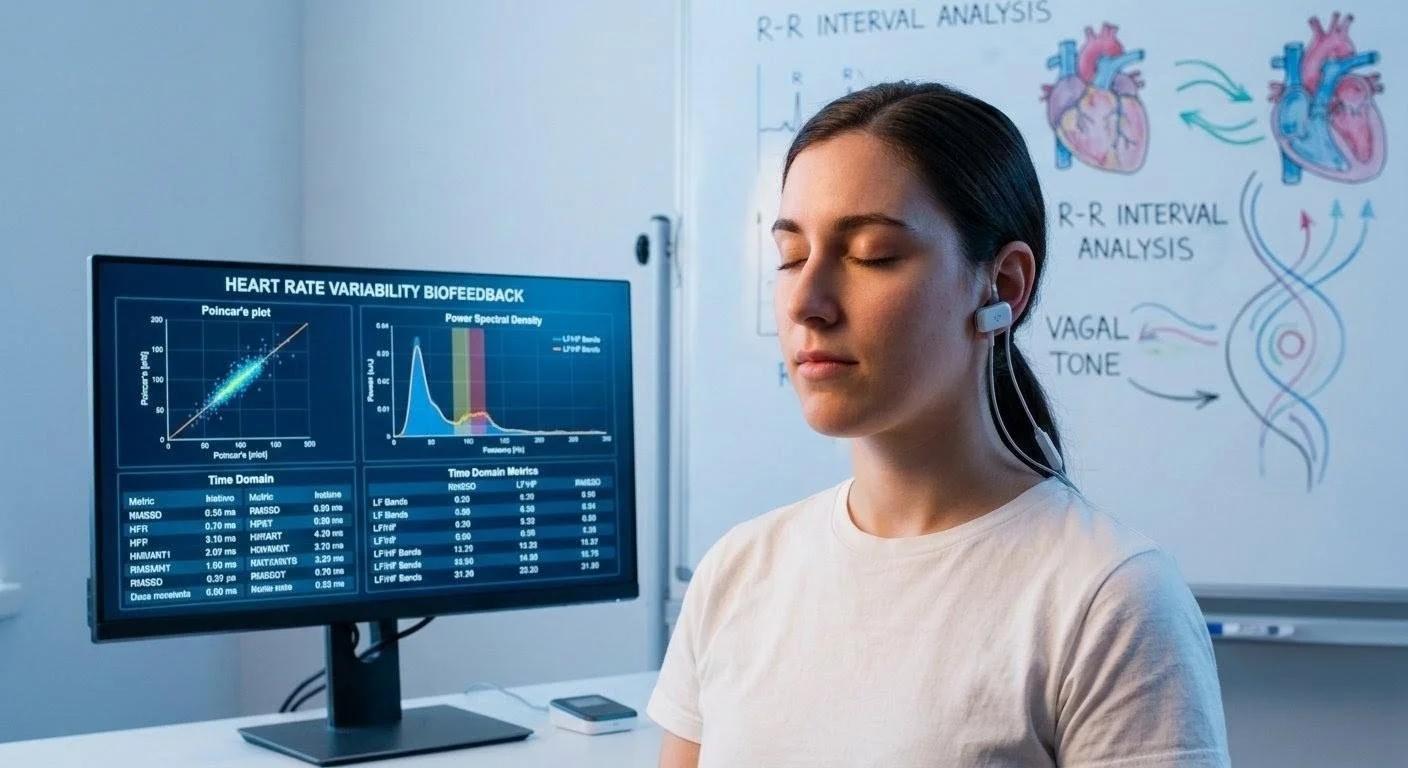
HRV Biofeedback Session
Early data on withdrawal and dependence was more limited, drawn from only two to four studies each, so those findings should be held as promising rather than proven. The researchers were careful to frame this as a call for larger, more rigorous trials, not a finished conclusion.
Lead author, Dr. Ariel Dart Roxburgh of Monash University, noted that with the vast majority of the world now carrying a smartphone, breath based tools have real potential as a low cost, accessible addition to addiction treatment, not a replacement for it.
The Techniques Studied
It is worth naming what "controlled breathing" actually meant across these 20 studies, because the variety itself is instructive:
Heart rate variability biofeedback, using sensor feedback to pace the breath to the heartbeat.
Resonant breathing, approximating that same pace without equipment, generally around six breaths per minute.
Yogic breathing, including multi part practices that vary the speed, depth, and length of breath retention.
A practice combining slow breathing with smiling, yawning, and positive self talk.
Breath patterns that intentionally mimic the rhythm of smoking, as a substitution technique.
Three part breathing, moving attention through the abdomen, lower chest, and upper chest in sequence.
Readers of this blog will recognize some of these patterns immediately. Three part breathing, in particular, closely resembles what many of us know as Dirgha Pranayama (DEER-gah prah-nah-YAH-mah), the three part breath, a foundational practice in Hatha Yoga that most new students learn in their very first class.
What This Looks Like Through an Ayurvedic Lens
In Ayurveda, Prana (PRAH-nah), the vital life force, moves through the body along subtle channels, and the breath is understood as one of its most direct doorways. A craving, from this view, is not only a mental event. It is a disturbance in the movement of Vayu (VAH-yoo), the air element and principle of movement in the body, and that disturbance is felt first and most clearly in the breath.
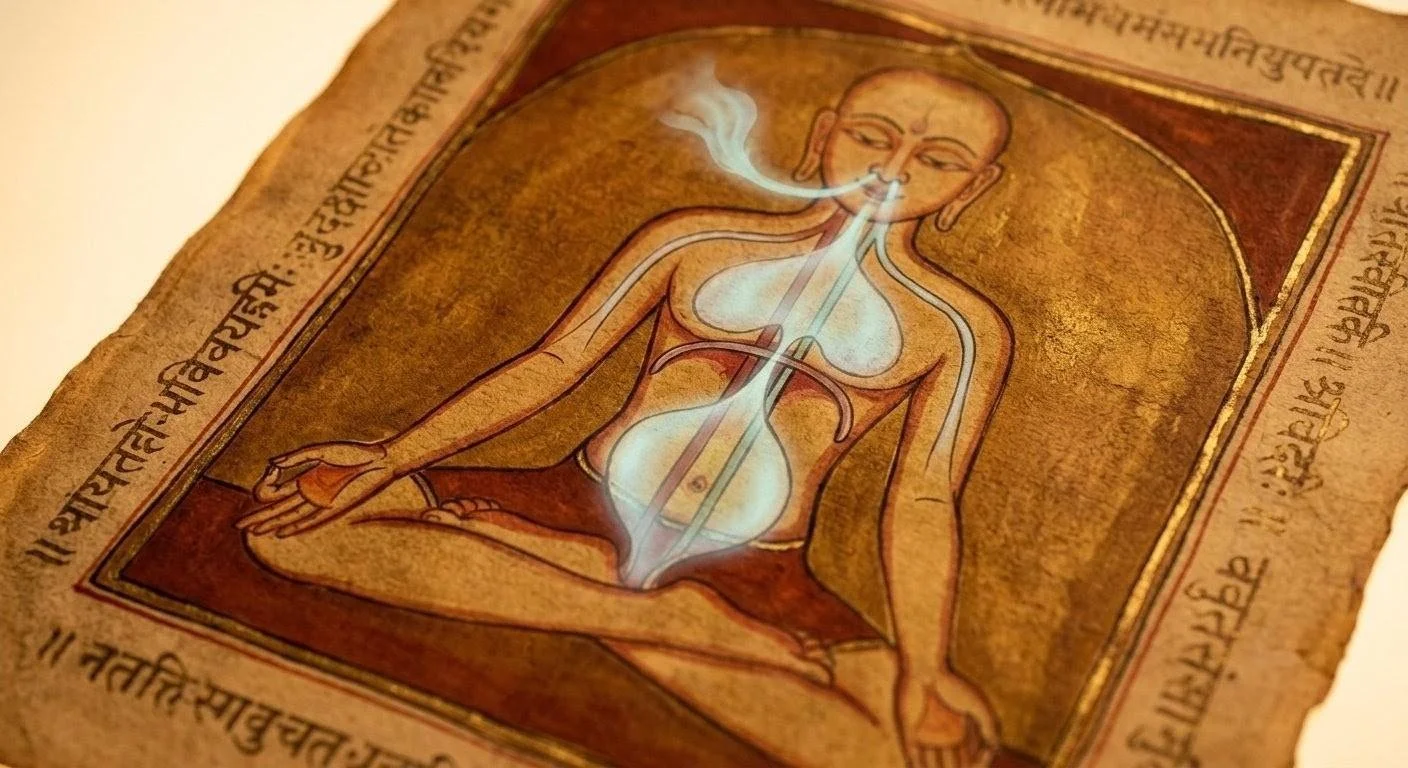
The peer reviewed research and this ancient understanding are describing the same territory, one in the language of statistics and controlled trials, the other in the language of subtle energy and lived experience. I find it moving when they arrive at the same doorway from such different directions.
Pranayama (prah-nah-YAH-mah), breath control or breath extension, has long been taught as a way to steady a mind that has been pulled off course; whether by grief, fear, or craving. Techniques like three part breath, alternate nostril breathing, and simple slow counted breathing are not new tools. What is new is a body of clinical evidence confirming they measurably work, even for something as difficult to interrupt as substance craving.
A Gentle Practice to Try
If you or someone you love is navigating recovery, here is a simple starting place inspired by both the study and traditional three part breath. This is offered as a supportive practice, not a treatment, and works best alongside qualified medical and addiction support.

Find a comfortable seated position. Let the exhale be slightly longer than the inhale. Breathe in gently, into the belly three times, feeling the breath move into the belly and out of the belly by connecting your hands to your belly space. Then, moving your hands to your ribs, breathe into the lower ribs three times. Then breathe into the upper chest, hands resting at the heart space, for three breaths.
Next, move one hand to your belly and one hand to your chest. Inhale, directing the breath first into the belly, then the ribs, then into the chest. Pause briefly at the top. Exhale slowly in reverse, upper chest first, then ribs, then belly. Continue for five to ten rounds, or as long as feels supportive in the moment.
The invitation is not to force the craving away, but simply to give the breath somewhere steady to land.
Fill your cup first,
Jennifer Misterka 🍵💕