
Gratitude grows through small, repeated practices, not grand gestures.
This season can bring travel, full houses, and a lot of family time. Even loving gatherings can stretch our nervous systems.
That is exactly when a few simple anchors can help. Each practice below takes only a few minutes. You are warmly invited to choose the ones that feel doable, and to leave the rest.
In this post, you will find:
A morning ritual and an evening ritual
A gentle movement practice
A breath practice
A creative art practice
A nature connection practice
A 10-minute gratitude meditation script using Havening Techniques
In Sanskrit, gratitude can be expressed as kṛtajñatā (krit-uh-gyuh-TAH), which means "knowing what has been done for us." It is an awareness of the care, effort, and support that meet us each day.
You are welcome to practice at home, in a car, at an airport gate, or in a quiet corner of a busy house.
Morning Ritual: Begin With What Is Already Here (3 to 5 minutes)
A gentle start can set the tone for the whole day. You might try this before reaching for your phone.
1. Notice your first breath of the day. Let your eyes stay soft.
2. Place one hand on your heart and one on your belly. Feel the rise and fall.
3. Silently name three things you are grateful for. Small is welcome: a warm blanket, a working kettle, a text from a friend.
4. Let each one land in your body. You might ask, "Where do I feel this?"
5. Bring your palms together at your heart in Anjali Mudra (UN-jah-lee MOO-drah, "offering gesture"). Set a simple intention for the day, such as "I invite ease."
6. Take one slow breath in, and one slow breath out, before you rise.
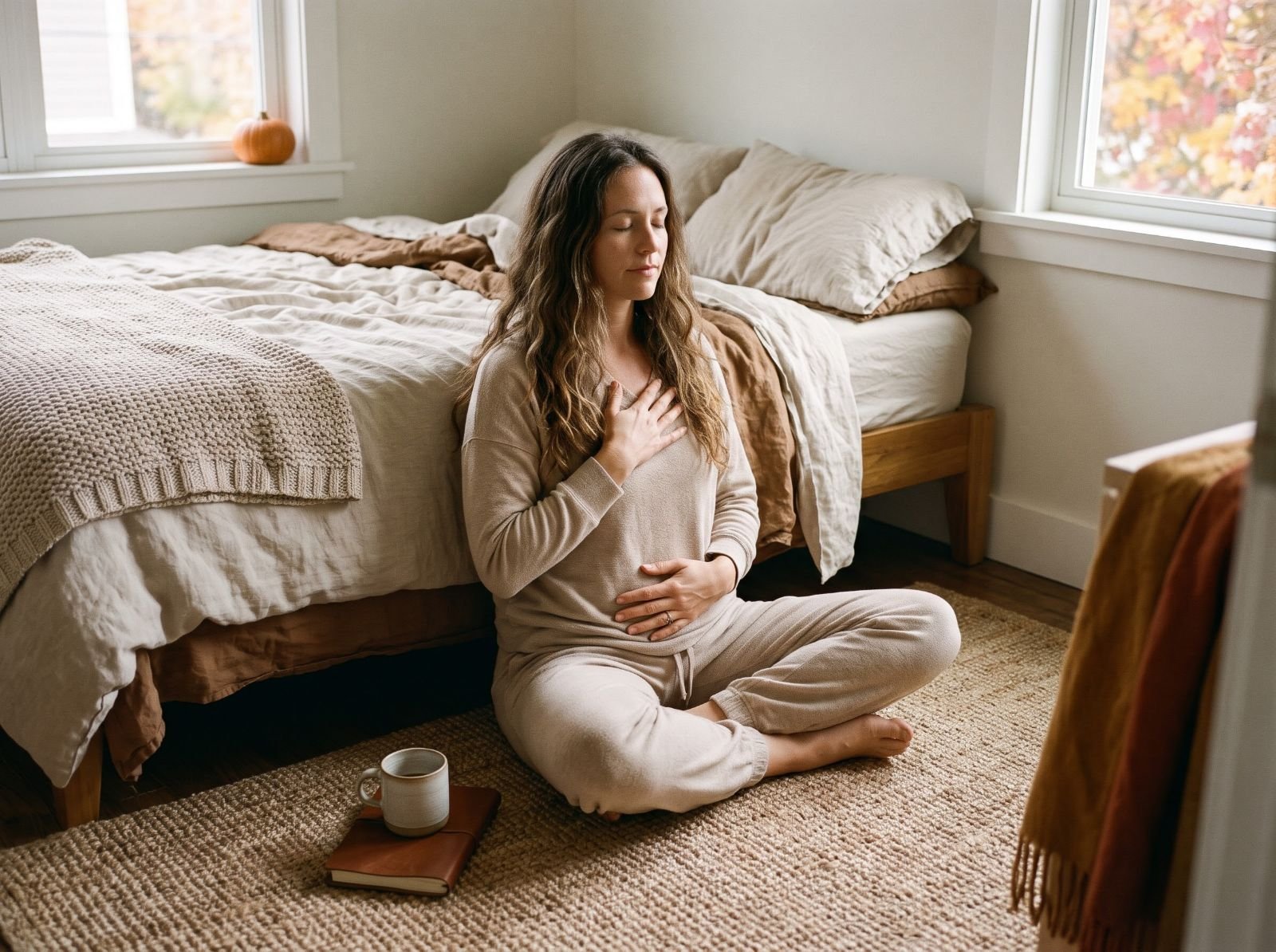
Start the day by taking a moment to feel the beautiful breath.
Holiday or travel variation: Keep it to one breath and one thing you appreciate. That still counts.
Ayurvedic note: The classical Ayurvedic daily routine is called dinacharya (dee-nah-CHAR-yah, "daily conduct"). Gentle, steady mornings are a long-held theme in that tradition.
Movement Practice: Gratitude in the Body (5 to 8 minutes)
This short flow blends Yoga, Qigong, and somatic movement. Move at your own pace, and skip anything that does not feel right for your body.
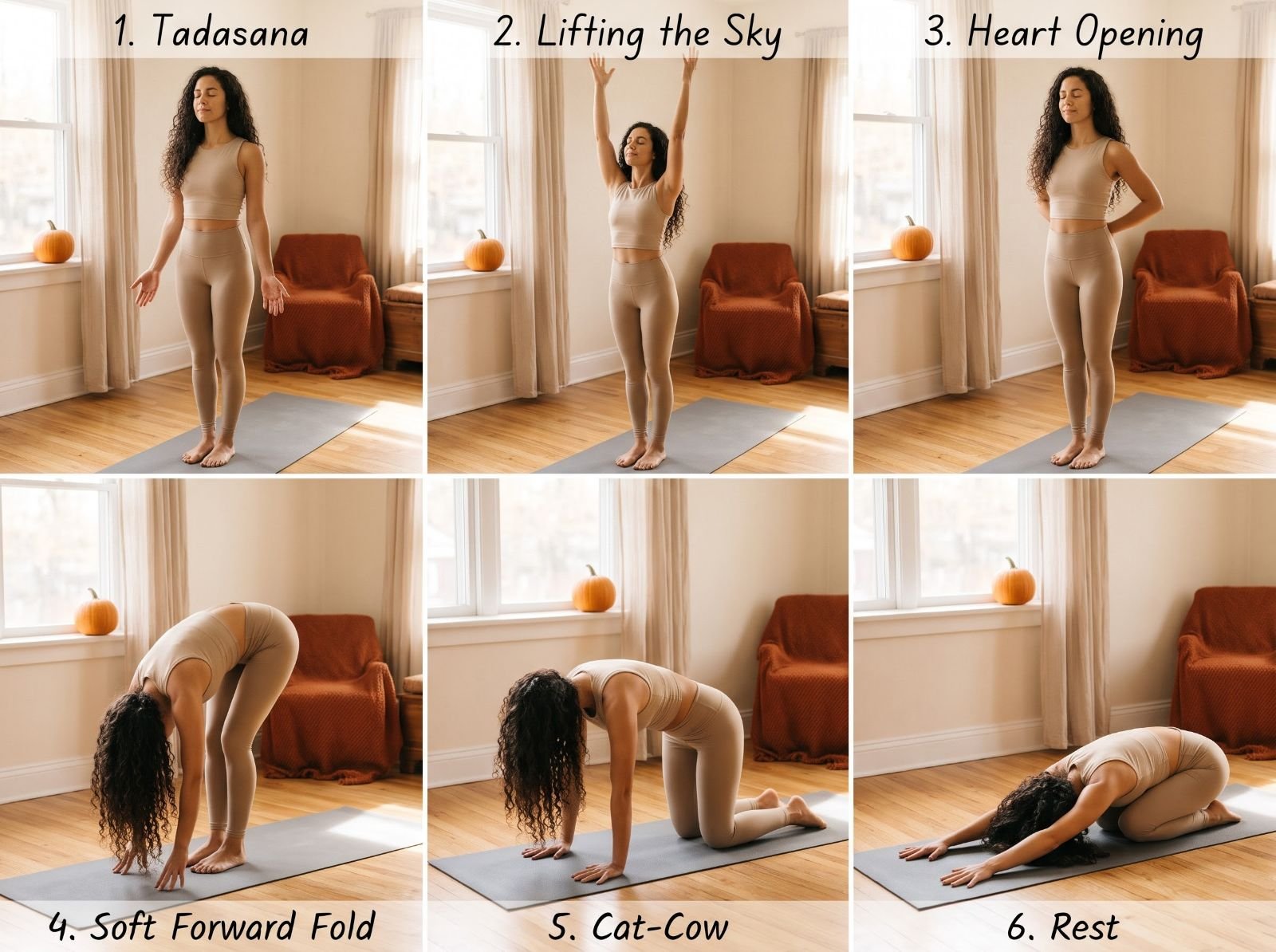
1. Stand and arrive. Stand in Tadasana (mountain pose). Feel your feet. Take three easy breaths.
2. Lifting the sky. Inhale and float your arms out and up, palms facing the sky. Exhale and lower the palms toward the earth. Repeat 5 to 8 times. You might silently say "thank you" as the hands rise.
3. Heart opening. Interlace your fingers behind your back, or hold a towel or strap. Inhale and lift your chest gently. Breathe here for 3 breaths.
4. Soft forward fold. Exhale and fold forward with bent knees. Let your head and arms hang heavy. Think of thanking your spine for holding you all day.
5. Cat-Cow. Come to hands and knees if that feels good. Move slowly between arching and rounding your spine for 6 breaths.
6. Rest. Lower into Child's Pose, or lie on your back. Let your hands rest on your heart. Notice what feels different.
Travel variation: Standing or seated versions of steps 2, 3, and 4 can be done in a hotel room, a hallway, or beside your car.
Breath Practice: The Grateful Exhale (3 minutes)
Pranayama (prah-nah-YAH-mah, "extension of life force") is the practice of working with the breath. This simple version pairs a longer exhale with a sense of appreciation.
You are invited to try this seated or lying down:
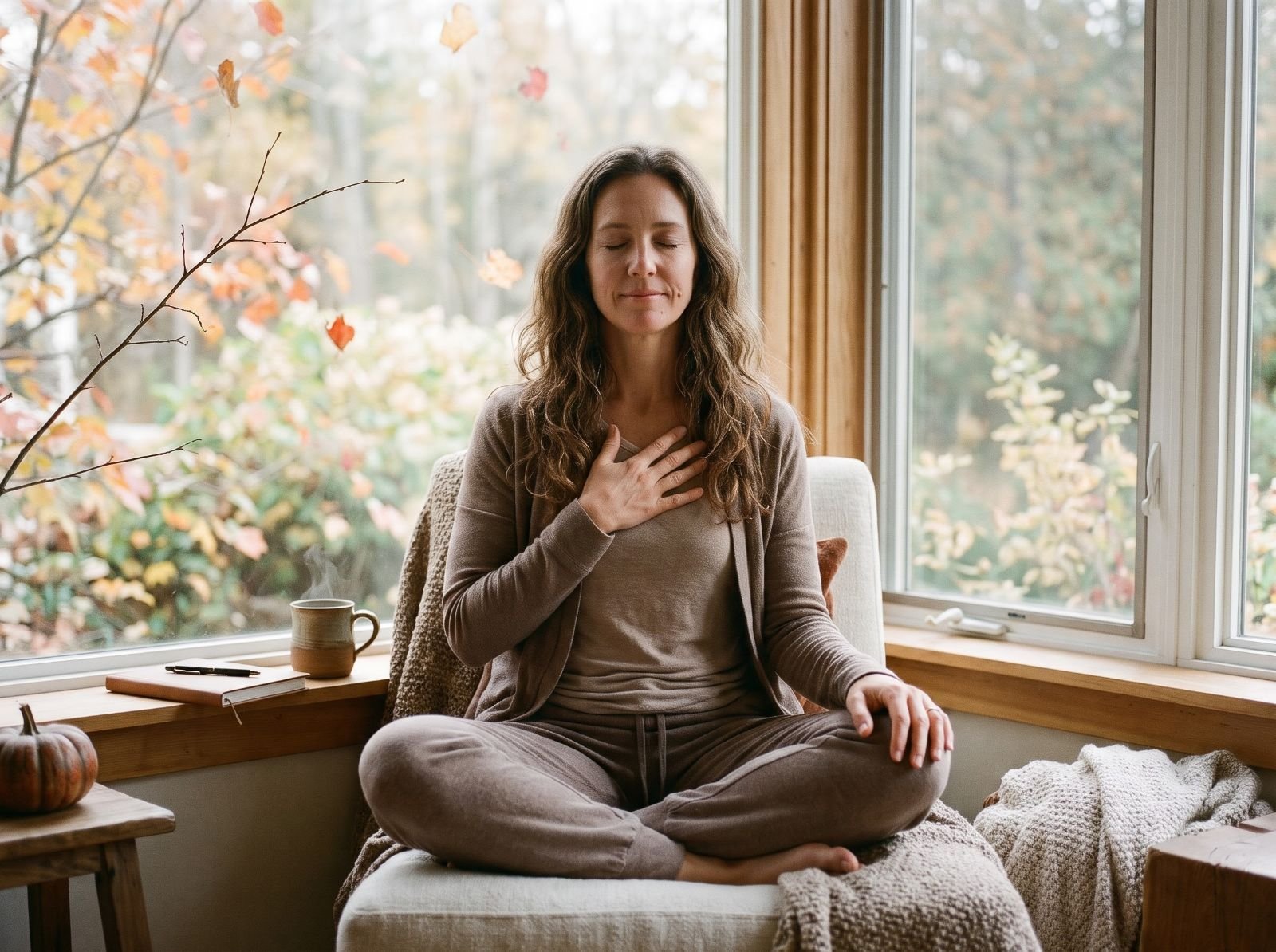
1. Rest one hand on your heart.
2. Breathe in through the nose for a comfortable count of 4.
3. Breathe out slowly through the nose for a count of 6, or whatever feels easy.
4. On each inhale, you might silently say, "I receive."
5. On each exhale, you might silently say, "I give thanks."
6. Continue for 2 to 3 minutes. Let the counts soften if they feel strained.
Optional hum: Bhramari (brah-MAH-ree, "bee breath") adds a soft humming sound on the exhale. Many people find the vibration soothing in the face and chest. You can keep the lips closed and the hum gentle.
If you feel lightheaded, you might return to your natural breath. Anyone with a medical condition that affects breathing may wish to check in with their healthcare provider before trying breath practices.
Stressful moment variation: Try 3 rounds of the grateful exhale in a parking lot, a restroom, or a quiet corner before walking into a gathering.
Creative Art Practice: Make Something Small and Thankful (10 minutes)
You do not need artistic skill. The invitation is to let your hands express what words may not.
Choose one of these, or follow your own spark:
Gratitude color wash. Pick 3 colors that match three things you appreciate. Let them blend on paper with crayons, markers, or watercolors.
One-line drawing. Without lifting your pen, draw an object you are thankful for. Wobbly lines are welcome.
Thank-you postcard. Write 2 or 3 sentences to someone who has supported you. You can mail it, or simply keep it.
Leaf or flower rubbing. Place a leaf under paper and rub with a crayon. Write one word of thanks beside it.
Gratitude jar. Write one appreciation per slip of paper. Fold it into a jar and read them together at the end of the season.
A few gentle guidelines:
Keep it small and unhurried.
Let it be imperfect.
Notice how you feel afterward, rather than judging the result.
Travel variation: A pocket notebook and one pen are enough. A 2-minute sketch in a waiting room counts.
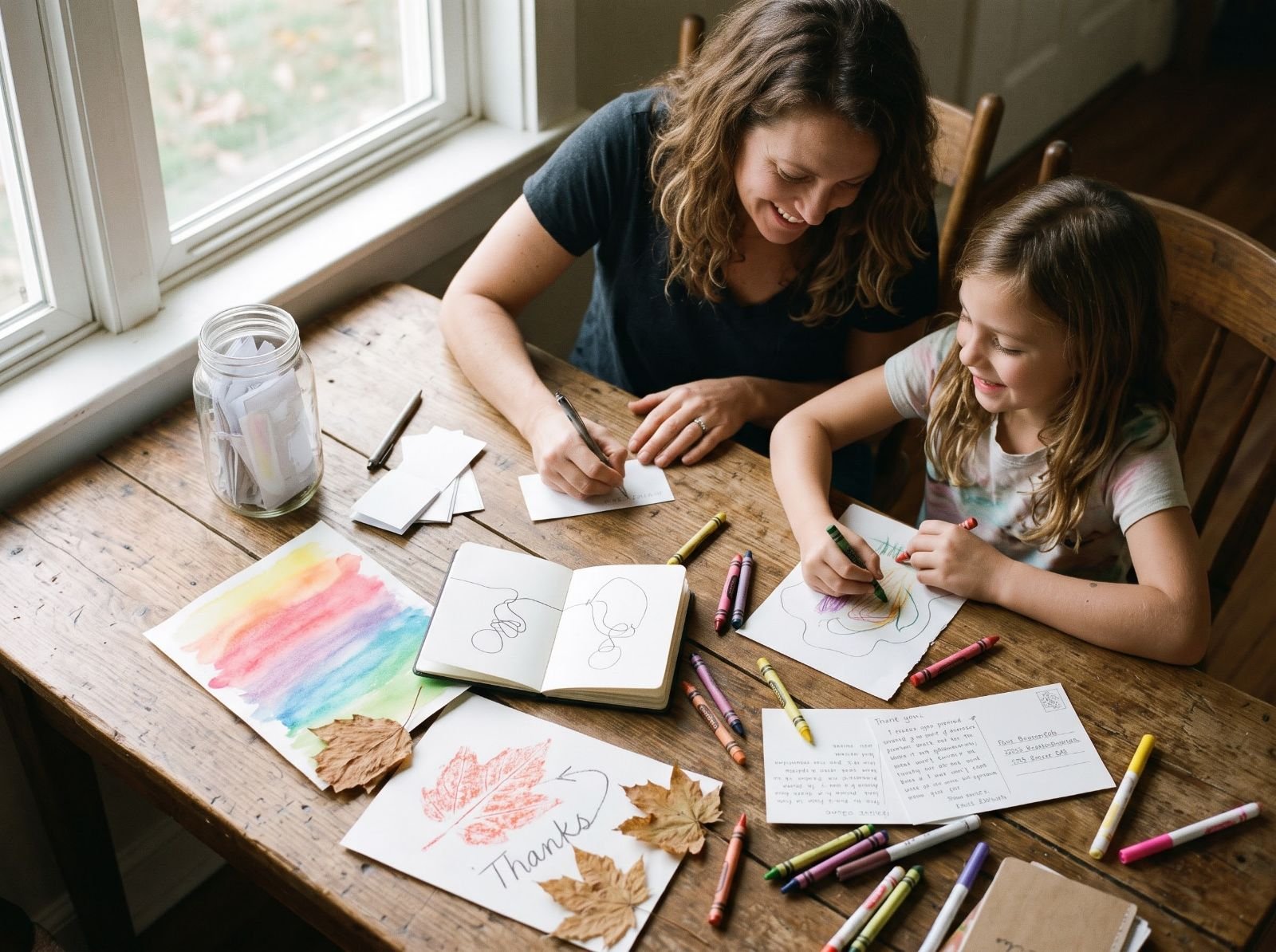
Shared variation: Invite a child, a cousin, or a grandparent to make a thank-you card alongside you. Creating side by side can ease conversation.
Nature Connection Practice: A Thank-You Walk (10 minutes)
Nature offers a steady, nonjudgmental presence. Even a few minutes outside can help us feel held by something larger than our to-do list.
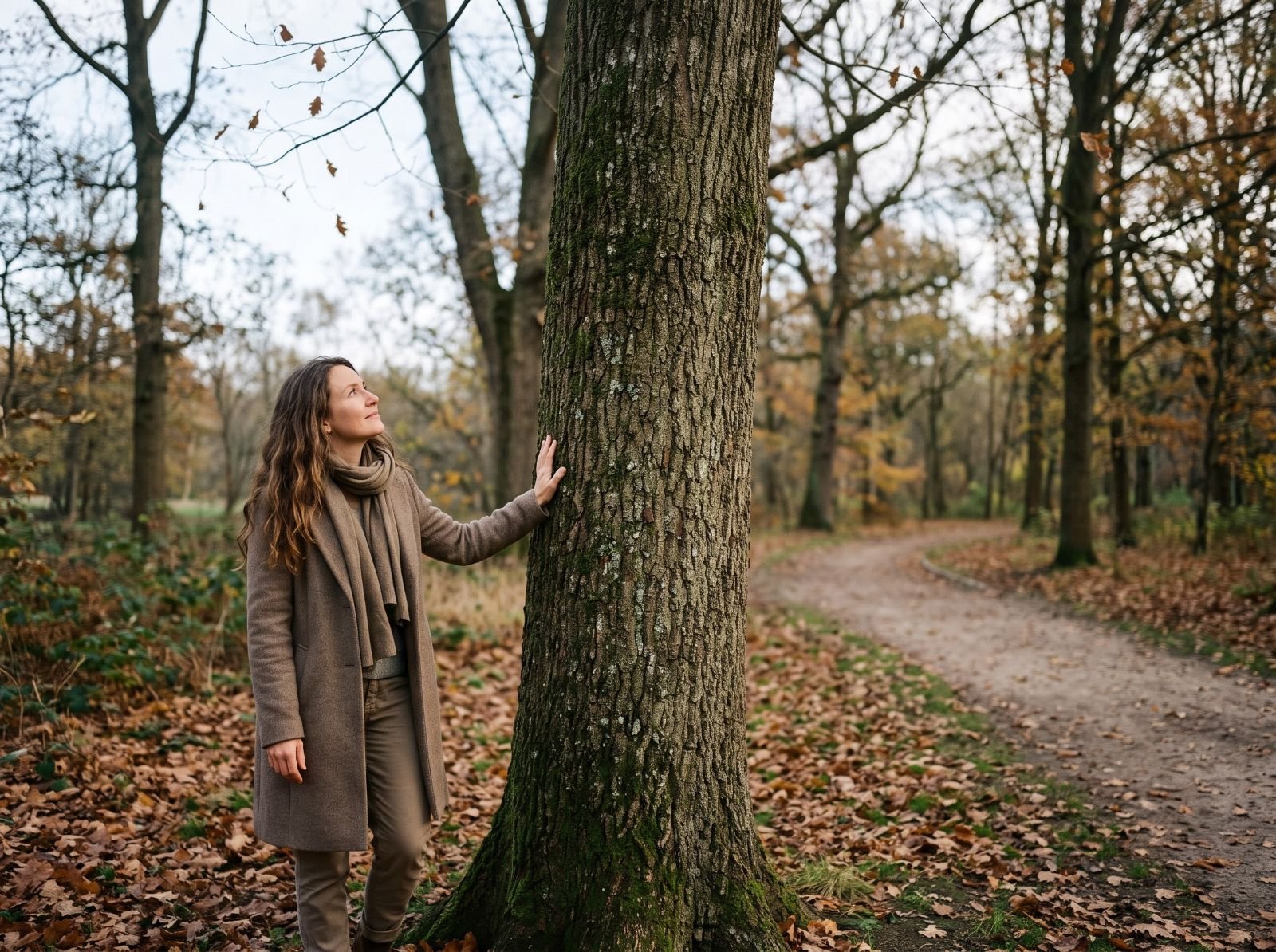
You are invited to step outside, ideally without your phone, and let your senses lead.
1. See. Find something that catches your eye, such as a bare branch, a patch of moss, or a shifting cloud. Silently thank it for being here.
2. Hear. Listen for the farthest sound, then the nearest. Appreciate the layers of sound around you.
3. Feel. Place a hand on a tree, a stone, or the ground. You might feel the temperature and texture. Thank the earth for supporting your steps.
4. Smell. Take a slow breath. Notice the scent of leaves, cold air, woodsmoke, or rain.
5. Pause. Find a spot to sit or stand for one full minute. Rest in simply being here.
When you finish, you might offer a small closing gesture. Place a hand on your heart, bow slightly, and say "thank you."
Seasonal note: In late autumn, falling leaves can be a lovely teacher. They remind us that letting go is a natural part of the cycle.
Travel variation: Step outside a rest stop, find a window with sky, or look up at the clouds from the car. A few moments of looking at the sky counts.
If you have a favorite tree or a spot in your yard, you might return to it each day. Familiar places can deepen a sense of belonging.
Evening Ritual: Let the Day Settle (5 to 10 minutes)
An evening ritual can help the day feel complete. You might begin about an hour before sleep, if that suits your household.
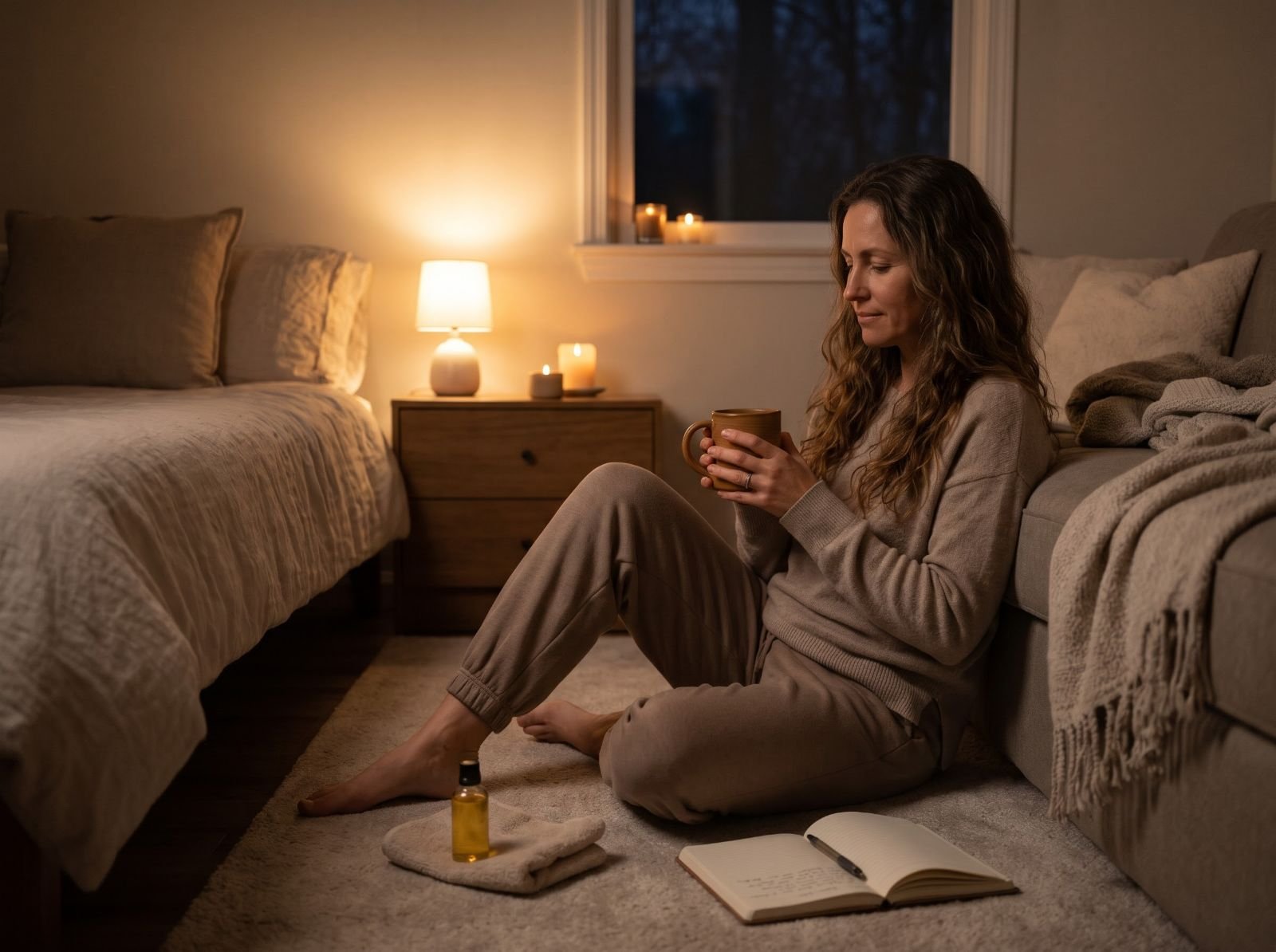
1. Soften the light. Dim lamps or switch to candlelight if it feels safe and cozy.
2. Warm something. Hold a cup of warm herbal tea or warm water. Feel the warmth in your hands as you sip.
3. Offer your feet some care. Padabhyanga (pah-dah-BYUHN-gah, "foot massage with oil") is a traditional Ayurvedic self-care practice. A few minutes of warm oil massage on the feet before bed is a long-held favorite. Plain lotion is a fine substitute. Anyone with oil sensitivities may prefer to skip it.
4. Name three good things. Write or say them aloud: one thing that went well, one person you appreciated, and one thing your body did for you.
5. Release the rest. On a slow exhale, you might imagine setting down anything unfinished. Tomorrow can hold it.
6. Close with thanks. Place your hands on your heart. Silently say, "Thank you for this day, just as it was."
Hard day variation: If gratitude feels out of reach, that is okay. You might simply notice one small comfort, such as a soft pillow or a quiet room. Gratitude does not require ignoring difficulty. It can sit alongside it.
A note on frameworks: Writing down three good things is a modern, research-informed gratitude practice. Foot massage and a calm evening routine come from Ayurvedic tradition. They are offered here side by side, each with its own roots.
A 10-Minute Gratitude Meditation With Havening Touch
Travel and family time can leave the nervous system feeling stirred up. This meditation pairs gratitude with Havening touch, a gentle form of self-touch.
This meditation includes Havening Touch. If touch is uncomfortable, you are welcome to imagine it instead. If strong emotions arise, you might open your eyes, look around the room, slow down, give yourself a hug and reach out for support.
A Gentle Closing
You do not need to do all of these practices. Even one small ritual can change the feel of a day.
Here is a simple way to begin:
Choose one morning practice and one evening practice.
Add a movement, breath, art, or nature practice when you have a little extra space.
Return to the meditation whenever the season feels like a lot.
Gratitude is not about pretending everything is easy. It is about noticing what is supportive, even in the midst of what is hard.
May your season be filled with ease, connection, and moments of thanks.
Fill your cup first,
Jennifer Misterka