
When Joint Care Shadows the Mind
What New Research and SVA Ayurveda Together Reveal About Whole-Body Healing
Have you ever noticed how a ripple in one corner of a quiet pond eventually finds its way across the entire surface? Our bodies move in much the same way, not as a collection of independent parts, but as a single, breathing wholeness.
In our modern wellness culture, we are often encouraged to treat symptoms in isolation: one supplement for the knees, another for sleep, something else for digestion. It is a well-intentioned approach. And yet, a striking new study reminds us why looking at the whole person, body, mind, and subtle channels together, is not just philosophical poetry. It is practical medicine.
What the Research Actually Says
A study published in June 2026 in the journal Nature Metabolism, led by Dr. Ramon Sun and colleagues at the University of Florida, examined the effects of glucosamine, one of the most widely used over-the-counter supplements for joint pain, on cognitive health.
The findings offer an important nuance that is easy to miss in how this story is being shared:
● For cognitively healthy adults: Earlier research has linked glucosamine to a lower risk of dementia. This new study does not contradict those findings.
● For those already experiencing early memory changes: People in the earliest stage of cognitive decline (mild cognitive impairment) who were taking glucosamine were found to be 25% more likely to progress to full Alzheimer’s disease. Among those already diagnosed with Alzheimer’s, glucosamine users were 25% more likely to die within five years compared to those who did not take it.
The distinction matters enormously. This is not a blanket condemnation of glucosamine. It is a cautionary signal for a specific population, and a profound reminder that a substance that supports one person's body may create unexpected burden in another's.
The Science Behind the Signal
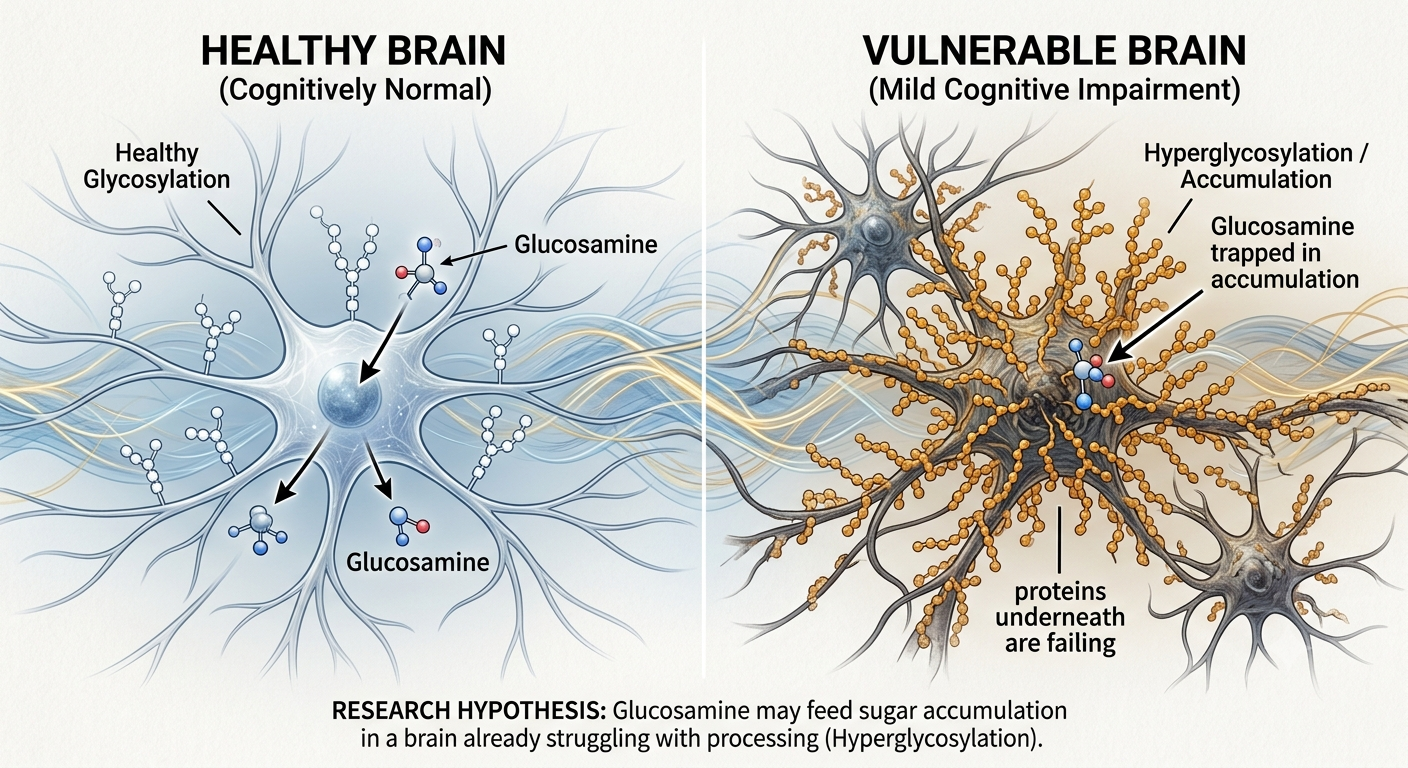
For more than a decade, Dr. Sun's team has studied how the brain processes sugar and what goes wrong in Alzheimer's disease. Their research points to a process called hyperglycosylation: in a vulnerable or aging brain, sugar chains called N-glycans accumulate on the surface of brain cells and proteins where they don’t belong. As these sugar coatings pile up, the proteins underneath them begin to fail, leading to memory loss and cell death.
The hypothesis is that glucosamine, an amino sugar molecule, may feed this accumulation in brains that are already struggling with this dynamic, while appearing harmless, or even helpful, in healthy brains where this process is not occurring.
It is worth noting that the study was based on patient health records rather than a randomized controlled trial, so it identifies an association rather than confirmed causation. The researchers are continuing to follow patients who discontinued glucosamine to better understand the relationship. This is science in its honest, iterative form: important signal, ongoing inquiry.
"While glucosamine appears safe and potentially protective for a healthy brain, it may be harmful for a brain that is already experiencing cognitive decline."
- "The Conversation”, June 2026.
The Lens of Shaka Vansiya Ayurveda
In the sacred lineage of Shaka Vansiya Ayurveda (SVA), passed down by Vaidya Rama Kant Mishra (pronounced Vaid-yuh Rah-muh Kunt Mish-ruh) and carried forward through dedicated teachers and practitioners, we do not view joint stiffness and cognitive health as separate concerns. They are intimately linked through the movement of Prana (vital life energy) and the integrity of our subtle channels.
When we look at joint discomfort through the SVA framework, two primary energies are often at play:
Vyana Vata (pronounced Vyah-nuh Vah-tuh)
This subdosha of Vata governs all circulation, the movement of nerve impulses, and the flow of energy throughout our joints and limbs. When Vyana Vata becomes aggravated through cold, dryness, irregular rhythm, or the accumulated weight of unprocessed stress, our joints begin to lose their natural lubrication and ease of movement.
Tarpaka Kapha (pronounced Tar-pah-kuh Kuh-fuh)
This nourishing subdosha is responsible for providing Soma, the cooling, lunar, sustaining quality that protects both the physical structures of our joints and the subtle channels (Shrotas) of the brain and nervous system. Tarpaka Kapha is sometimes described in SVA teachings as the “ghee in the lamp” of the mind: it keeps perception clear, memory intact, and the nervous system calm.
When Vyana Vata is chronically aggravated, it can, over time, begin to dry and disturb Tarpaka Kapha. This is why, in SVA, joint discomfort and cognitive fog are often understood as different expressions of the same underlying imbalance rather than two separate problems to be addressed separately.
Why Isolated Supplementation Can Disrupt the Channels
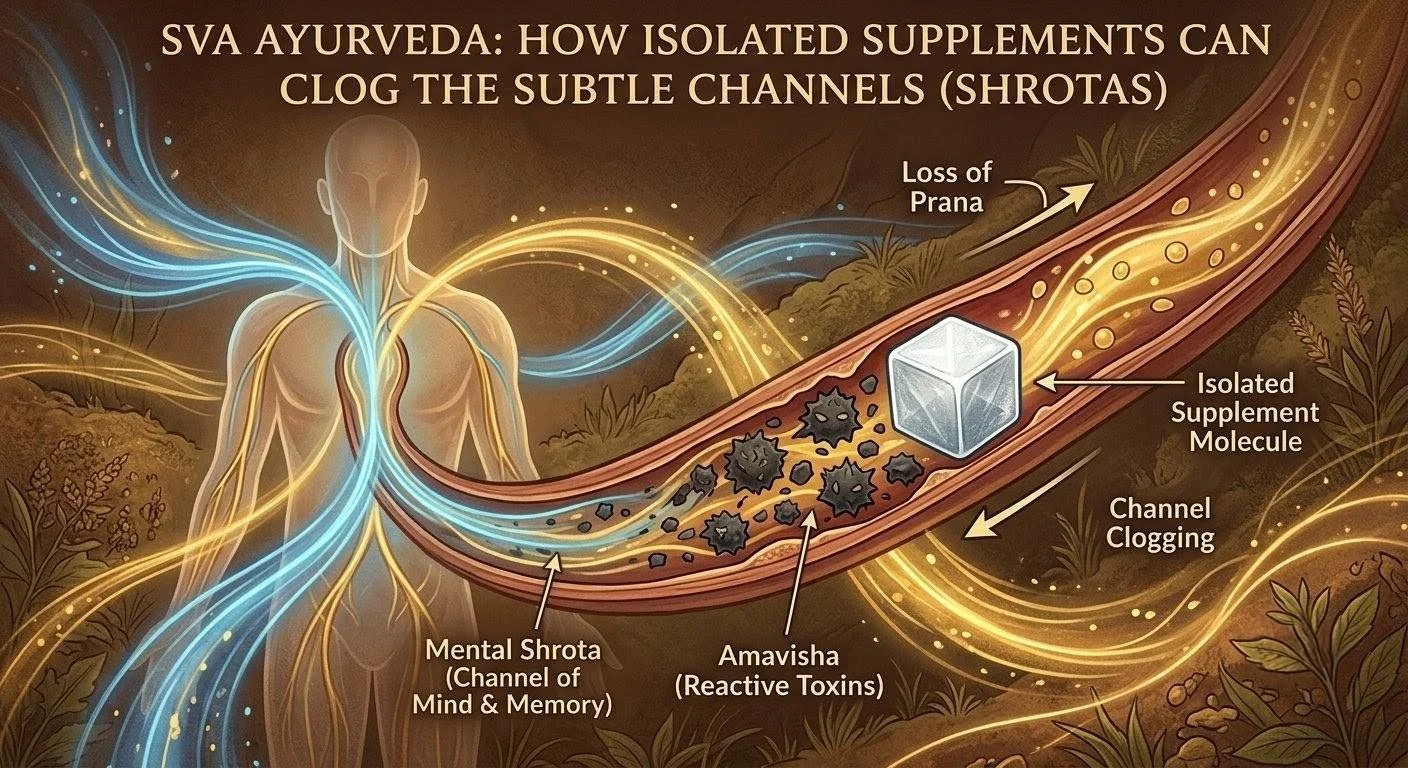
In SVA, one of the primary concerns with isolated, highly concentrated substances, whether synthetic supplements or even isolated herbal extracts removed from their whole-food context, is their relationship to Amavisha (pronounced Ah-muh-vee-shuh): reactive, partially digested toxins that accumulate when our Agni (digestive and metabolic intelligence) cannot fully process what it is given.
Most of us in the modern world carry some degree of Amavisha, accumulated from environmental exposures, processed foods, chronic stress, and the relentless pace of contemporary life. When a heavy, isolated molecule like a concentrated amino sugar supplement enters a system already managing this accumulation, there is a real risk that it cannot be cleanly metabolized and integrated. Instead, it may begin to clog the Shrotas, the micro-channels through which Prana, nutrition, and intelligence flow, eventually clouding the subtle channels that nourish the brain and memory.
This is not a one-size-fits-all pronouncement. Just as the research shows glucosamine affects healthy and vulnerable brains differently, SVA would look carefully at a person’s constitution, their Agni, their current accumulation of Amavisha, and the state of their Shrotas before drawing conclusions about any substance. It is always the whole picture that matters.
An Invitation to Whole-Body Support
True nourishment does not ask us to choose between our knees and our memory. Ayurveda offers us a path toward both, one that works with the body’s own intelligence rather than flooding it with isolated signals. These are some of the gentlest, most foundational practices from the SVA tradition and our integrated approach here at Luminous Path:
1. Support the Channels Through Cooling and Mineralization
In SVA, many presentations of joint stiffness involve an undercurrent of excess heat (Pitta aggravation) drying out the natural moisture and lubrication of the joints. Cooling the channels gently, without suppressing digestive fire, is a first step.
● Fennel (saunf): This is used freely in the SVA tradition as a beautiful, gentle way to cool and clarify the channels. Sipped as a warm tea or chewed as seeds after meals, it supports digestion while gently moving excess heat.
● Soma Salt: This prized, cooling rock salt emphasized by Vaidya Mishra, distinct from heating sea or table salts, helps to mineralize the body in a way the channels can recognize and integrate.
2. Transdermal Support via Marma Points
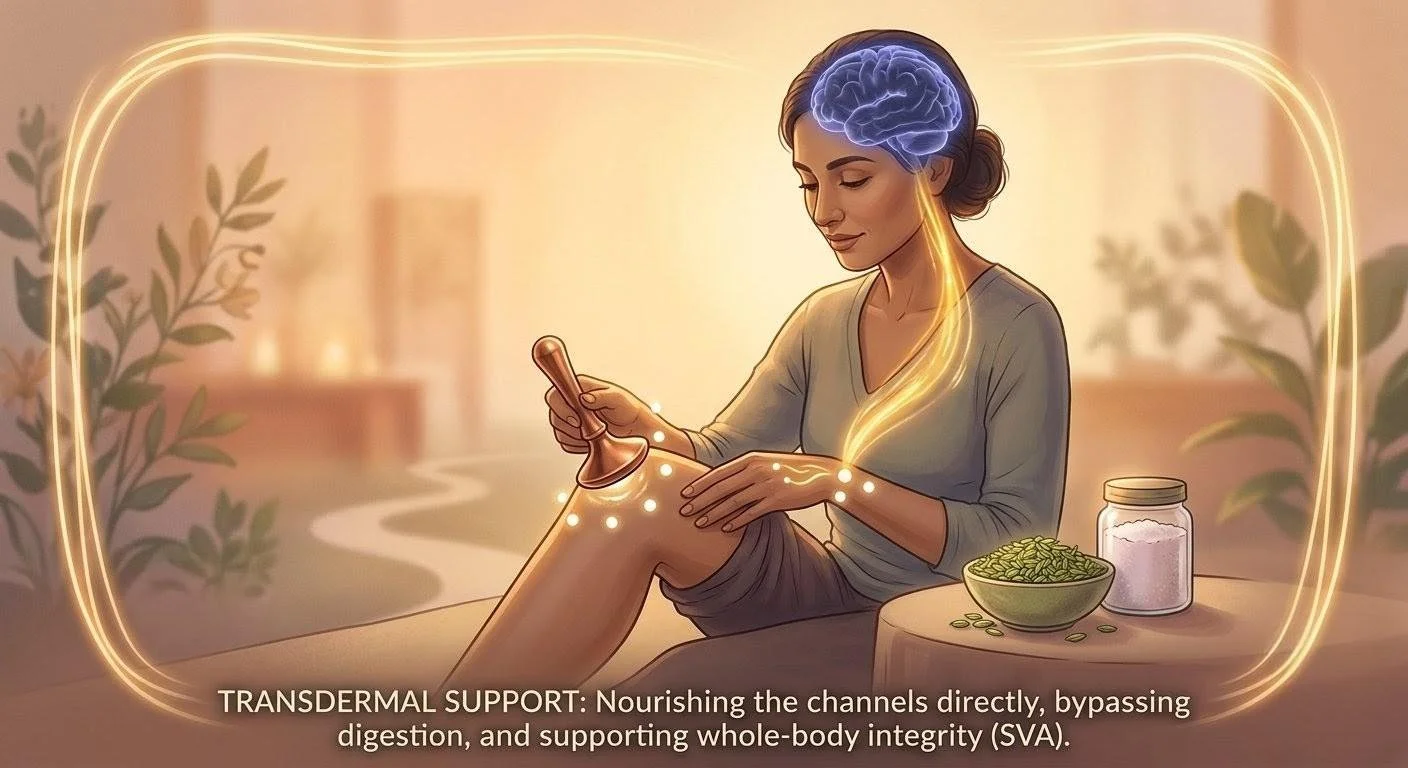
Rather than asking the digestive system to process concentrated isolated supplements, SVA emphasizes the power of delivering herbal intelligence directly through the skin to the Marma points, the vital energy intersections where Prana is most accessible. Transdermal herbal preparations, such as creams or oils infused with Boswellia or other joint-supportive herbs, applied gently over Marma points around the knees, ankles, and wrists can calm Vyana Vata directly, bypassing the liver and preserving the clarity of the internal channels.
This is one of the places where our Marma therapy and Kansa Wand sessions can be deeply supportive. If this feels like something worth exploring together, I’d love to talk with you about what a personalized session might look like.
3. Gentle Somatic Movement and Sound Healing
Joints thrive on space and gentle, intelligent circulation. Trauma-informed somatic movement, the kind we cultivate in our Yin and somatic yoga offerings, helps reintroduce fluid and Prana into the joint capsules without creating inflammation or depletion. When paired with sound healing, we invite the nervous system to downregulate, releasing the systemic tension that so often underlies both joint holding and cognitive fog. Vyana Vata is deeply responsive to rhythm, vibration, and warmth. Sound, breath, and gentle movement are some of its most natural medicines.
A Note on Discernment
If you or someone you love is currently taking glucosamine and has any concerns about cognitive health, please bring this conversation to your physician or neurologist. This blog is offered as educational reflection, not medical advice, and the research is still unfolding. What we can say with confidence is that the question is worth asking, and worth asking in partnership with providers who know your full picture.
SVA Ayurveda and modern research are not in opposition here. They are, in their own languages, pointing toward the same truth: the body is a living wholeness, and what we offer it should be offered with that wholeness in mind.
Your memory, your joints, your breath, and your spirit are weaving a single story. Let us tend that story together, with care and with reverence for everything you already are.
If you feel called to explore a personalized, gentle protocol that honors your unique constitution and supports both your physical ease and your cognitive clarity, I am always here to walk beside you.
Fill your cup first 🍵💕,
Jennifer Misterka
Luminous Path Yoga & Ayurvedic Wellness
Source Note
Sun R, et al. “Glucosamine supplementation and cognitive decline in Alzheimer’s disease.” Nature Metabolism, June 2026. Study led by Dr. Ramon Sun, University of Florida. As summarized by ScienceAlert (June 13, 2026) and The Conversation.
SVA Ayurvedic framework references: Teachings of Vaidya Rama Kant Mishra, Shaka Vansiya Ayurveda lineage.
This post is offered for educational purposes only and does not constitute medical advice. Please consult your physician or neurologist regarding any health decisions.