
The 21-Day Rhythm: Your Daily Path to Lasting Vitality
How small, consistent shifts in your daily routine create a lifetime of health.
The Power of 21 Days
Ayurvedic wisdom has long held that 21 days of sincere, consistent practice is enough to begin weaving a new thread into the fabric of your daily life. This tradition understands something that takes most of us years to learn: profound well-being doesn't arrive through radical overhaul. It arrives quietly, through the cumulative power of Dinacharya (dee-nah-CHAHR-yah), your daily rhythm.
Each small act you perform reinforces the next, creating a self-sustaining cycle of energy and clarity. Over time, these rhythms can soften the edges of restless sleep, steady a fluctuating mood, and bring a sharpness to your mind that no amount of coffee can replicate.

Week 1: The Morning Awakening
Begin your journey by aligning with the natural intelligence of the day.
Rise with the Light: Aim to wake during the sacred hour before sunrise, when the mind is naturally still and the air is freshest. Even waking 30 minutes earlier than usual is a meaningful beginning.
The First Sip: Before anything else enters your body, drink a cup of warm water. This simple act initiates the internal cleansing process and gently awakens your digestive system for the day ahead.
Clear the Channels: Use a metal tongue scraper, Jihwa Nirlekhana (jih-hwah nir-lay-kha-nah), to remove the overnight accumulation of toxins, known as Ama (AH-mah). This prevents their reabsorption, stimulates digestive reflex points, and takes less than a minute.
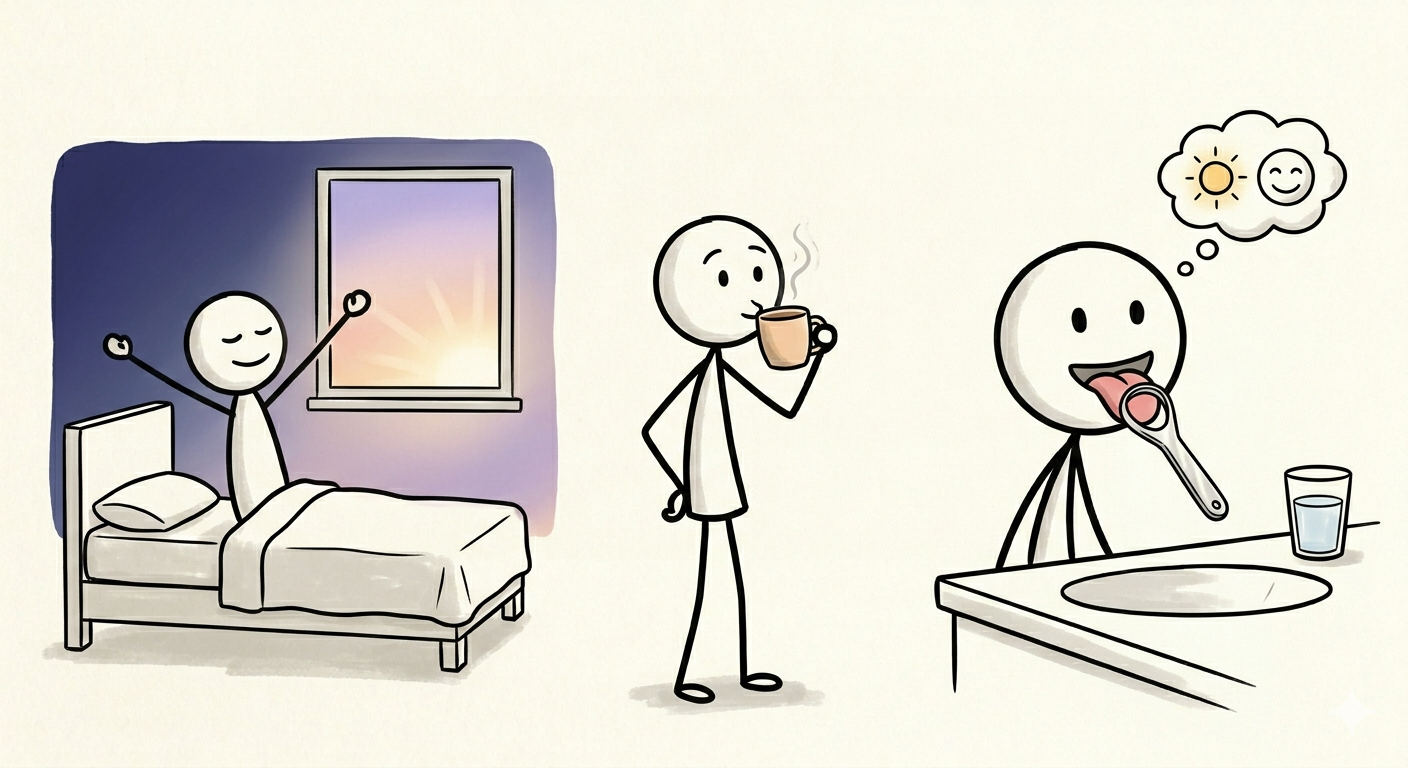
Week 1: rise, hydrate, and clear — three simple acts that begin everything.
Week 2: Nourishing the Temple
With your mornings established, add practices that ground the nervous system and kindle your metabolic fire.
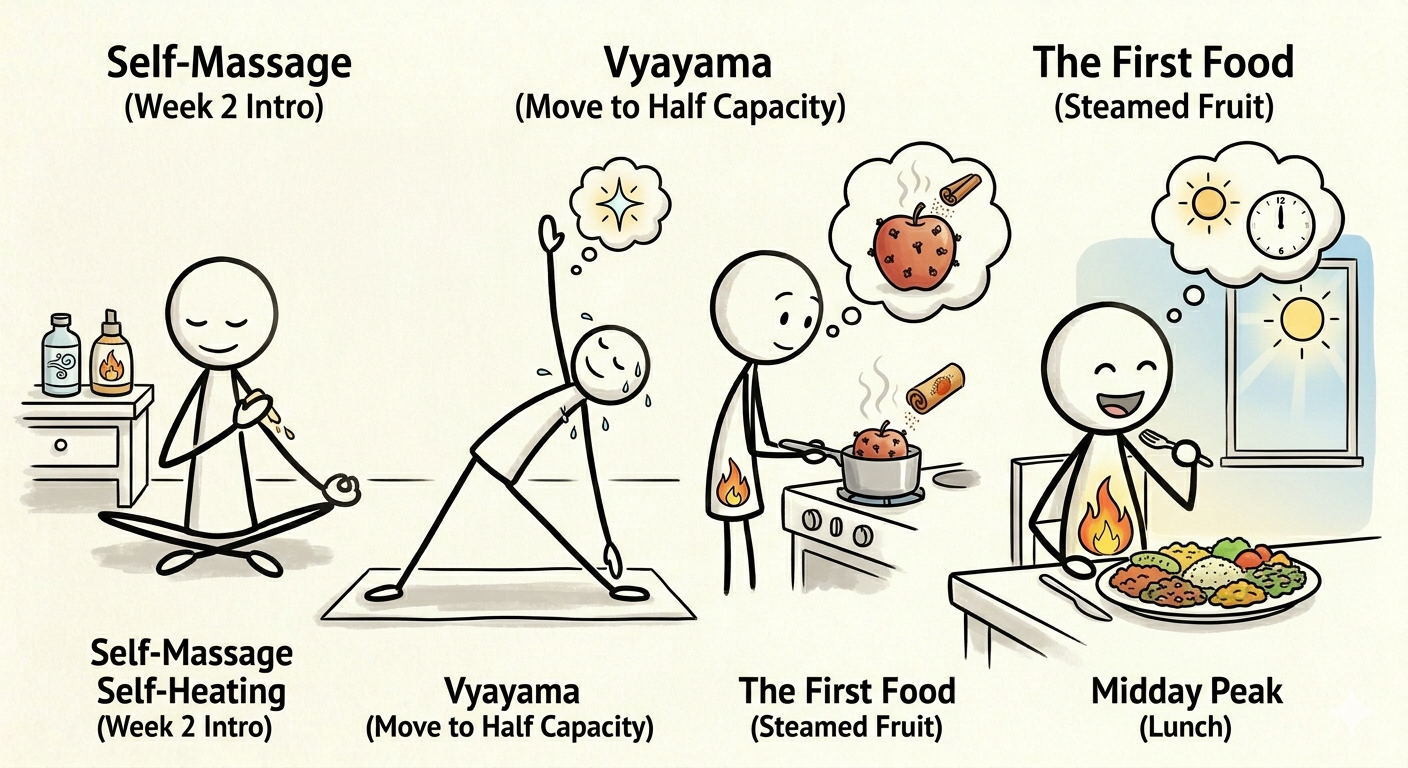
The 15-Minute Gift: Self-Massage
Dedicate 15 minutes to self-massage tailored to your constitution, because within the SVA tradition, the practice itself shifts depending on your dosha (DOH-shah), and the method matters as much as the oil.
🌬️ For Vata and Pitta Types: Abhyanga (ahb-HYAHN-gah) Oil Massage
Vata and Pitta types both benefit from warm oil self-massage. Please lovingly warm your oil first by resting the bottle in a bowl of warm water before you begin.
Choosing your oil:
Vata: A warming sesame and grapeseed oil base, enriched with grounding herbs like Ashwagandha (ahsh-wah-GAHN-dah), Brahmi (BRAH-mee), and Jatamansi (jah-tah-MAHN-see) to settle the nervous system.
Pitta: A cooling coconut oil base with Turmeric and Daru Haridra (DAH-roo hah-REE-drah) to clear heat from the tissues.
The Flow of Prana (PRAH-nah): Your Sequence
The sequence always gently follows the natural direction of prana, moving from the crown to the sole. Use enough oil for your hands to move freely across the skin without fully saturating it.
Head and Face: Begin at the scalp with gentle circular motions, then move to the face with soft downward strokes. Give special, caring attention to the ears.
Neck and Arms: Continue down the neck and into the shoulders. Use clockwise circular motions at every joint and long sweeping strokes down the bones of the arms, finishing with clockwise circles around each finger.
Chest and Torso: Please skip the heart area completely. No massage is applied there. Apply clockwise circles to the abdomen instead.
Back and Legs: Sweep down the back and circle around the hips. Sweep down the legs with clockwise circles at the knees, continuing down the lower legs to the feet. Complete the lower body by circling the feet, sweeping up and down, and making small circles around each toe.
🌿 For Kapha Types: Garshana (GAR-sha-na) Dry Massage
For Kapha types, or anywhere cellulite is present, skip the oil entirely and invite in a brisk dry massage with raw silk gloves.
The Technique: Follow the same gentle crown-to-sole sequence outlined above, but please omit the face, and spend extra time on any areas where cellulite is present.
The Benefits: The loving friction stimulates circulation, moves lymph, kindles Agni (AHG-nee), and cuts through the stagnation that Kapha is most prone to.
An Added Touch: An herbal powder, Udvartana (ud-var-TAH-nah), can also be beautifully paired with the gloves for added benefit.
💧 Closing the Practice
Whether choosing warm oil or dry brushing, complete the practice by bathing, allowing the water to gracefully carry away whatever the massage has loosened.
Move to Half Capacity
Following your morning hygiene and massage, dedicate time to gentle movement, Vyayama (vyah-YAH-mah). Ayurveda suggests exercising only to half your capacity: until you feel warmth and begin to lightly perspire at the forehead and armpits. This protects your vital energy, Ojas (OH-jus), rather than depleting it.
The First Food
After your movement is complete and your body has settled, offer your system its first nourishment of the day: a simply steamed pear or apple, cooked with cloves to infuse their warming intelligence into the fruit, with the cloves removed before eating.
In the SVA tradition, this timing is intentional. It supports the liver during its active morning hours and kindles Agni (AHG-nee) gently after movement has prepared the body to receive it. If you'd like a finishing touch, a dusting of Ceylon cinnamon makes a beautiful addition, kindling digestion and warming the system without overheating a sensitive constitution. It is a small act, but one that sets a harmonious metabolic tone for everything that follows.
Honor the Midday Peak
Make your midday meal, ideally between 11 a.m. and 1 p.m., the most substantial of the day. This is when your digestive fire burns brightest and is best equipped to transform food into pure nourishment.
Week 3: Harmony and Rest
Complete your rhythm by deepening the quality of your nourishment and the sanctity of your rest.
The Spectrum of Taste: Ensure your daily meals include all six tastes: sweet, sour, salty, pungent, bitter, and astringent. This is not about eating more; it's about eating completely. When all six tastes are present, the body feels genuinely satisfied, and lingering cravings tend to quiet on their own.
The Pillar of Sleep: Honor Nidra (NEE-drah), sleep, as one of the three foundational pillars of life. Aim to be in bed between 9 and 10 p.m.. This window is when the body does its deepest work: repairing tissues, consolidating memory, and regenerating vital essence. What you protect at night shapes everything you bring to the morning.

A Gentle Return
Completing this 21-day cycle is not a destination. It is the beginning of a lifelong relationship with your own nature.
There will be days of perfect rhythm, and days where you fall completely out of step. Both are part of the path. What matters, always, is that you return to these practices gently, without judgment, again and again. The rhythm is always waiting for you.
Fill your cup first 🍵💕,
Jennifer Misterka