
Knowing Your Nature: A Guide to Understanding Your Dosha
Why your constitution is more than a quiz - and how to begin reading the signs your body is already sending you.
The Art of Knowing
In the Shaka Vansiya Ayurvedic tradition - the lineage of Vaidya Rama Kant Mishra, carried forward today by practitioners like Dr. Doug Beech and Dr. Marianne Teitlebaum - there is a form of knowing so refined it can seem almost miraculous to the modern mind. It is called Nadi Pariksha(nah-dee pah-REEK-shah) - the ancient art of pulse diagnosis.
In the hands of a truly skilled Vaidya, the pulse becomes a living map. It reveals not just your current state of health but the deeper architecture of who you are - the elemental blueprint you arrived with at birth. This is your Prakriti(PRAH-krih-tee): your original nature, the unique ratio of the three doshas that was set at the moment of conception and shaped through the nine months of gestation that followed.
Prakriti, by its very nature, is subtle. Outside of the first eleven days of life - when it is most legible to a trained eye - it can be genuinely difficult to read with certainty. A masterful Vaidya with deep pulse training can still access it. For most of us, and even for many practitioners earlier in their journey, we work with what we can observe, feel, and honestly reflect upon.
And that is more than enough to begin.
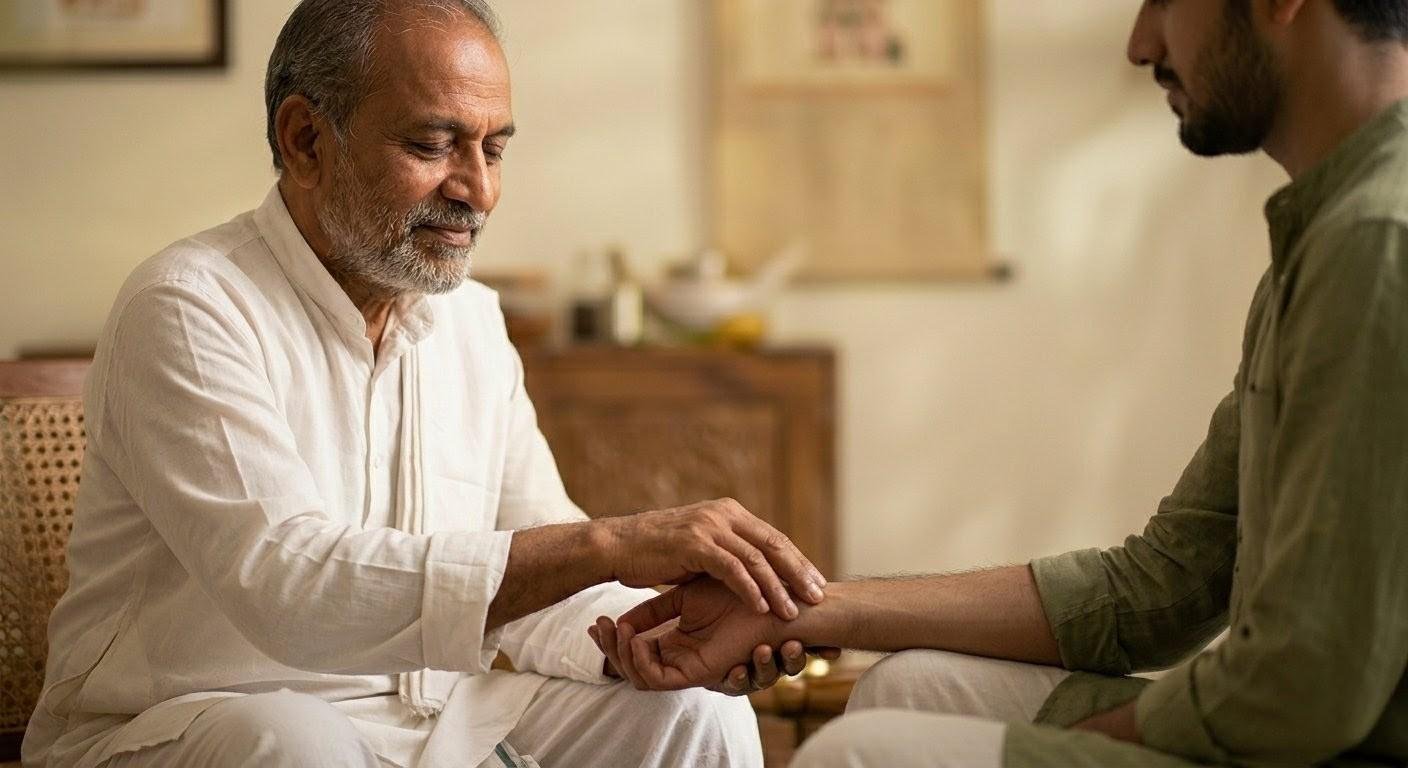
In the hands of a skilled Vaidya, the pulse becomes a living map.
Prakriti and Vikruti - Your Nature and Your Now
Before we explore the three doshas, it helps to understand two foundational concepts that most dosha quizzes fail to distinguish.
Your Prakriti(PRAH-krih-tee) is your original constitution. It is the proportion of Vata, Pitta, and Kapha you were born with. It does not change across your lifetime. It is, in a sense, your factory setting.
Your Vikruti(vih-KROO-tee) is your current state of imbalance. It is the way your doshas are expressing right now, shaped by your diet, your sleep, your stress, your environment, and the accumulated choices of your days. Vikruti can shift. That is precisely why it matters - because it points to what needs tending.
And what we are tending toward has a name in classical Ayurveda: Svastha(SVAHS-thah). Often translated simply as "health," Svastha carries a meaning far richer than the absence of disease. It means being fully established in the Self - a state of complete physical, mental, and spiritual balance in which body, mind, and spirit function in harmony with nature. Managing our Vikruti, layer by layer, is how we find our way back to Svastha. It is the quiet destination beneath all of this work.
Here is the honest truth for most people reading this: if you live in the modern world - particularly in the United States - your Vikruti is likely what you will identify most clearly when you explore the doshas. And that is not a failure. It is information. It is your body pointing you toward what needs to change.
A Word About American Physiology
One of the reasons I practice within the Shaka Vansiya Ayurvedic lineage - while also drawing on the wisdom of other Ayurvedic traditions - is that SVA specifically addresses the reality of modern Western bodies.
Vaidya Mishra spent decades living and teaching in the West. He observed something that traditional Ayurvedic texts, written for people living very differently in ancient India, could not fully anticipate: that Americans, as a culture, tend toward overwork, irregular eating, late nights, and diets heavy in processed, poorly prepared foods eaten at the wrong times. The result, seen again and again in clinical practice, is a chronically overheated liver.
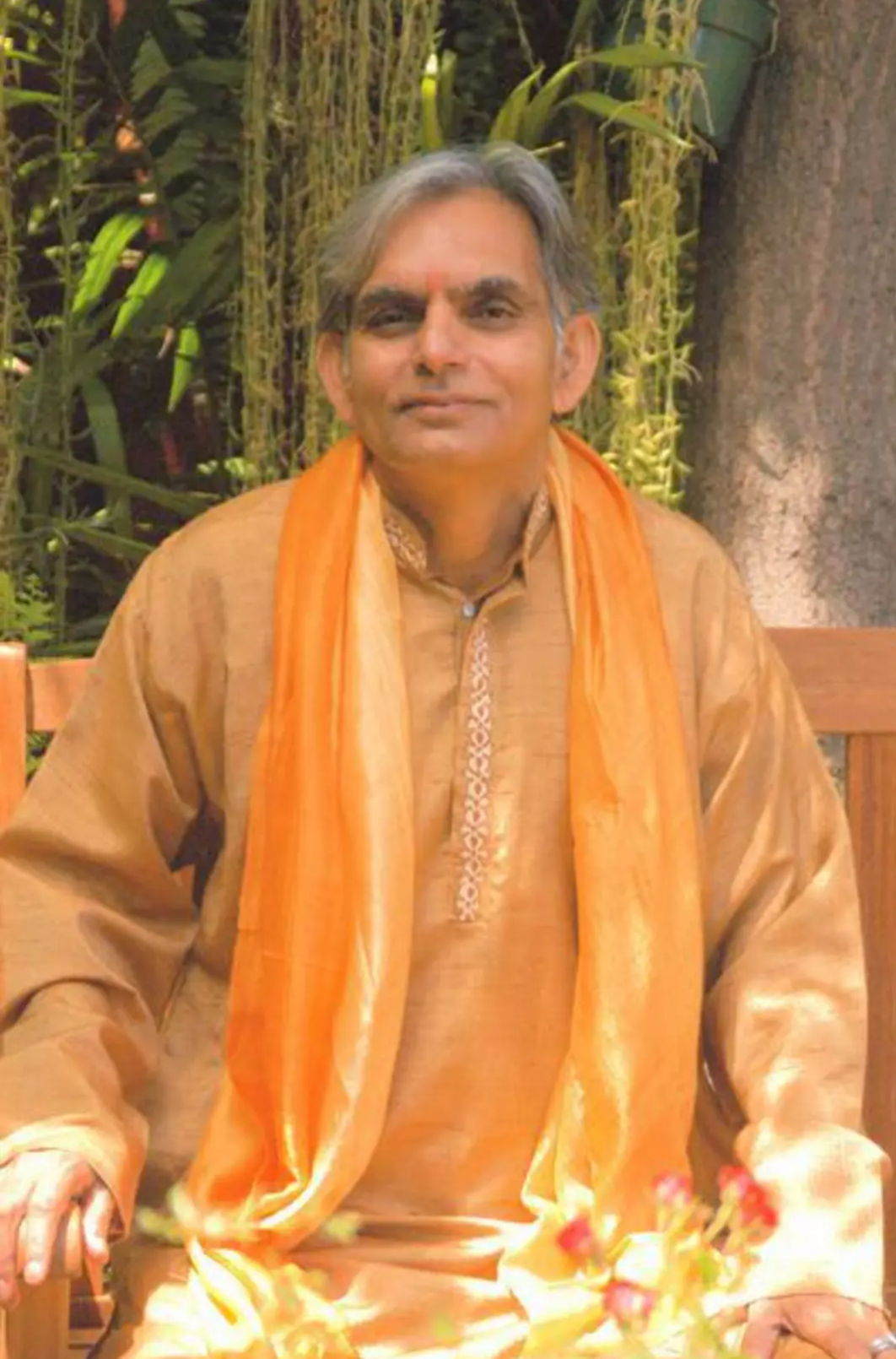
Vaidya Rama Kant Mishra
In Ayurvedic terms, this means most Americans are walking around with significant Pitta aggravation - regardless of their underlying constitution. A person who is fundamentally Vata may be expressing Pitta imbalance. A natural Kapha may be running hot in ways that confuse the picture. This is one reason SVA formulations and protocols are specifically designed to address liver heat and modern physiological stress, and why I find this lineage so well suited to the people I work with here.
Other lineages of Ayurveda that I study and deeply respect were developed in response to the bodies and climates of their own regions - and they are brilliant within that context. Honoring multiple lineages has taught me that constitution is not one-size-fits-all, and neither is wisdom.
With all of that said - let us explore the doshas.
The Three Doshas - Principles of Life
Every human being is made of all three doshas. Vata, Pitta, and Kapha are not personality types or boxes to check - they are living biological forces, each one a unique combination of the five great elements: Earth, Water, Fire, Air, and Ether. What varies from person to person is the proportion in which they arise.
Vata - The Force of Movement

Vata — Air + Ether, the animating principle of all movement.
Air + Ether
Vata governs all movement in the body and mind - the breath, the heartbeat, the flow of nerve impulses, the movement of food through the digestive tract, the arising and passing of thoughts. It is the animating principle of life itself. Without Vata, nothing moves. Without Vata, Pitta and Kapha cannot function at all.
In balance, Vata brings:
Creativity, enthusiasm, adaptability, quickness of mind, a natural lightness and joy, inspired speech, and the beautiful capacity to initiate and envision.
Physical qualities:
A naturally light or slender frame that may be difficult to maintain weight on. Skin that tends toward dryness. Hair that is fine, sometimes coarse or frizzy. Cold hands and feet. Variable appetite and digestion - sometimes strong, sometimes barely present. Light, easily interrupted sleep. A tendency toward constipation when out of balance. Joints that may crack or pop. Veins that are often visible beneath the skin.
Emotionally and mentally:
Quick to learn, quick to forget. Loves novelty and variety. May struggle with consistency and follow-through. Prone to anxiety, worry, and overwhelm when out of balance. The mind moves fast - sometimes faster than the body can keep up.
Signs of Vata imbalance - and where to begin:
Anxiety, racing thoughts, insomnia, constipation, bloating and gas, dry skin, joint pain, irregular digestion, feeling scattered or ungrounded, difficulty making decisions, fatigue without the ability to rest. The nervous system is calling out for lubrication - both internally through nourishing, warm, unctuous foods, and externally through Snehana(sneh-AH-nah), the practice of warm oil self-massage.
In the SVA tradition, a sesame and grapeseed oil base enriched with grounding herbs like Ashwagandha, Brahmi, and Jatamansi is particularly indicated for calming an aggravated Vata. If this speaks to you, our next post explores exactly how to bring this practice into your daily rhythm.

Abhyanga with SVA Vata Calming oil
Pitta - The Force of Transformation

Pitta — Fire + Water, the force that transforms everything you take in.
Fire + Water
Pitta governs all transformation - the digestion of food, the metabolism of experience, the processing of emotion, the sharpness of intellect. It is the fire that converts what we take in - food, sensory impressions, ideas - into something the body and mind can use.
In balance, Pitta brings:
Sharp intelligence, clarity of perception, strong digestion, natural leadership, courage, precision, and a compelling drive to understand and achieve.
Physical qualities:
A medium, well-proportioned frame. Skin that is warm to the touch, often fair or ruddy, prone to flushing, redness, rashes, or freckles. Hair that may be fine, prone to early graying or thinning. Strong appetite - Pitta types often cannot skip meals without irritability. Profuse perspiration. Eyes that are sharp and penetrating, sometimes sensitive to light. Loose stools or tendency toward inflammation in the digestive tract.
Emotionally and mentally:
Focused, goal-oriented, and decisive. Can become irritable, impatient, or critical under pressure. Prone to perfectionism. The classic overachiever. When Pitta flares, that sharp mind can turn cutting - toward others and toward the self.
Signs of Pitta imbalance - and where to begin:
Anger, irritability, inflammation anywhere in the body, acid reflux or heartburn, loose stools or diarrhea, skin breakouts or rashes, excessive body heat, intolerance to heat or direct sun, intense hunger with mood changes when meals are delayed, judgmental or controlling tendencies, burnout from overwork. Clearing heat from the liver and digestive system begins with what and when you eat. Favoring cooling, liver-supportive foods and making your midday meal - between 11 a.m. and 1 p.m. - the largest of the day works directly with Agni at its peak, allowing the body to transform food efficiently rather than generating additional heat. Our next post explores how to build this and other cooling rhythms into your daily life.

Cooling, liver-supportive foods
Note: As mentioned above, Pitta imbalance - and particularly liver heat - is extraordinarily common in modern American life, even among people whose underlying constitution is primarily Vata or Kapha. If you recognize yourself strongly in this section, it may be your Vikruti speaking rather than your Prakriti.
Kapha - The Force of Structure

Kapha — Earth + Water, the force that holds everything together.
Earth + Water
Kapha provides the body with its form, its substance, its lubrication, and its endurance. It is the principle of stability and nourishment - the quality that holds everything together and sustains life across time. Kapha governs the body's tissues, its immunity, its capacity for love, loyalty, and deep, abiding calm.
In balance, Kapha brings:
Steadiness, patience, physical strength and stamina, deep loyalty, a nurturing and compassionate presence, excellent long-term memory, and a natural groundedness that others find deeply comforting.
Physical qualities:
A larger, well-built frame with a tendency to gain weight easily and lose it slowly. Skin that is smooth, cool, and often quite beautiful. Thick, lustrous hair. Deep, resonant voice. Strong joints. Slow but very steady digestion. Heavy, sound sleep - sometimes too much of it. A tendency toward congestion, mucus, and water retention.
Emotionally and mentally:
Loyal, loving, and consistent. Slow to anger but also slow to forgive once truly hurt. Tendency toward attachment. Can become complacent, resistant to change, or withdrawn when out of balance. The deep feeler of the three types.
Signs of Kapha imbalance - and where to begin:
Weight gain, lethargy, depression or emotional flatness, congestion and sinus issues, excessive sleep without feeling rested, slow digestion, attachment and difficulty letting go, resistance to change, possessiveness, and a general heaviness that descends over the body and spirit.
Where Vata calls for warm oil, Kapha calls for stimulation and movement. In the SVA tradition, Kapha types skip oil massage entirely in favor of Garshana(GAR-sha-na) - a brisk dry massage performed with raw silk gloves. The friction kindles Agni, moves lymph, improves circulation, and cuts through the stagnation that Kapha is prone to. An herbal powder, Udvartana(ud-var-TAH-nah), can also be used alongside the gloves for additional stimulating benefit. Our next post shows you exactly how to bring this into a daily practice.

Garshana: dry, massage silk gloves for brisk, loving friction.
Most of Us Are a Combination
Very few people are a pure single dosha. Most of us arrive with two doshas that are roughly co-dominant, Vata-Pitta, Pitta-Kapha, Vata-Kapha, with the third playing a quieter supporting role. A smaller number are genuinely tridoshic, with all three in relatively equal proportion. This is considered a rare and fortunate constitution, though it brings its own complexity.
When reading the descriptions above, you may find that you resonate clearly with one dosha in the physical realm and another in the emotional or mental realm. That is entirely normal. Notice where the resonance is strongest and most consistent - not in your worst moments, but in your baseline tendencies across your lifetime.
Ask yourself: What have I been like since childhood, when life was simpler and less shaped by stress and habit? That question often points closer to Prakriti than any snapshot of the present moment.
Working With What You Know
If after reading this you find yourself thinking - I'm not sure, there are pieces of all three that feel true - you are in good company. That uncertainty is honest. It may mean your Vikruti is genuinely obscuring your Prakriti. It may mean you are a dual or tridoshic type. It may simply mean that the nuances of your constitution deserve more than a blog post can offer.
What you can do right now is this: notice which imbalances feel most present in your body today. Start there. Work to reduce the aggravation you can identify - and watch what begins to clarify underneath. That movement toward clarity, toward ease, toward balance - that is the movement toward Svastha. Toward being fully established in your own nature.
And when you are ready for the deeper knowing - the kind that can only come through a trained eye, an experienced hand, and a lineage that has been reading these patterns for five thousand years - a personalized consultation is always available to you.

Your nature is not a mystery to be solved. It is a relationship to be cultivated, one gentle, consistent day at a time.
Fill your cup first 🍵💕,
Jennifer Misterka