
The Sacred Mirror: Motherhood, Maya, and the Dance of Non-Duality
In the traditional celebration of Mother’s Day, we often focus on the external: the flowers, the brunch, the cards. But as we walk the Luminous Path, we are invited to look deeper. This year, I want to explore one of the most complex concepts in Advaita Vedanta—the concept of Maya—and how it serves as the ultimate spiritual architecture of motherhood.

Redefining Maya: Illusion or Creative Power?
In many spiritual circles, Maya is translated as "illusion" - the veil that hides the Truth of Brahman (Ultimate Reality). But in the context of the Divine Mother, Maya is also Shakti: the manifest power of the universe.
Motherhood is the most tangible expression of Maya. A mother literally manifests a soul into a physical form. She creates the "veil" of the body, the personality, and the life. From a Vedantic perspective, motherhood is the bridge between the Unmanifest (the soul) and the Manifest (the child).
The Paradox of "Mine" and "Not Mine"

The greatest challenge of motherhood - and the core of Advaita - is the dance between attachment and liberation.
In Vedanta, we speak of Moha, or deluded attachment. As mothers, our biology screams at us to believe this child is "ours." We feel their pain, we celebrate their wins, and we often lose our own identity in theirs. This is the powerful "spell" of Maya.
While the emotional bond is vital for survival, the spiritual goal is to recognize the Atman (the soul) within the child. To be a mother in the spirit of Advaita is to hold two truths at once:
The Relative Truth: This is my child, and I must nourish, protect, and love them fiercely.
The Absolute Truth: This soul belongs only to the Divine. They are a temporary guest in my home, and we are both expressions of the exact same consciousness.

The Mother as the First Guru
In the Vedic tradition, the mother is considered the first Guru. Why? Because she is the child's first encounter with the concept of "The Other." How a mother loves teaches a child how the Universe loves.
When a mother practices Viveka (discernment), she begins to see through the "Maya" of her child’s behavior, their successes, or their failures. She looks past the "roles" they play and sees the light within them. In doing so, she isn't just raising a human; she is witnessing a god in disguise.
A Somatic Note for the Luminous Mother
Because the "spell" of motherhood is so physically and emotionally demanding, it can easily knock us out of Sattva (balance). The intense responsibility can create a "Rajasic" state of constant doing.
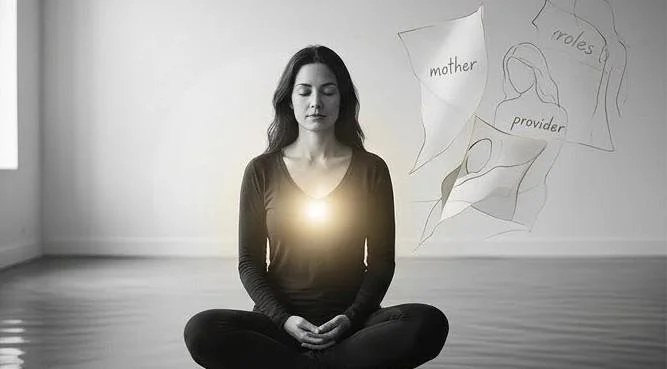
This Mother’s Day, I invite you to practice the "Witness" meditation.
Sit quietly for five minutes.
Notice the roles you play: Mother, Daughter, Provider, Caretaker.
Slowly peel them away like layers of an onion.
What remains is the "I AM"—the luminous, unchanging spark that existed before you were a mother and will exist long after.
By recognizing the Maya of our roles, we can actually love more deeply, because we are no longer loving out of need or attachment, but out of the pure recognition of our shared divinity.