
Saying Goodbye to Summer, Hello to Fall
🌿 Hello Luminous Soul ✨
As the light begins to shift and the air carries the first hints of fall, here is a short and gentle Yoga sequence to help the body adjust, along with a nature informed ritual to help the heart say goodbye to summer and welcome what's next.
A Word on the Season, According to Ayurveda
As summer gives way to fall, the elements of Air and Space, Vayu and Akasha (VAH-yoo, AH-kah-shah), begin to move into the foreground. These elements bring dry, cool, and light qualities into the world around us, and into our bodies as well.
This is the season when Vata accumulates. When Vata moves out of balance, it can show up in ways that touch both body and mind.
Digestion, or Agni, can become erratic (vishamagni, vish-uh-MAHG-nee, "irregular fire"), leaving appetite unpredictable. You might feel hungry one moment and lose interest the next.
Physically, this can look like dry skin, chapped lips, brittle hair, stiff joints, or irregular digestion, gas, and bloating.
Mentally and emotionally, it can show up as anxiety, racing thoughts, a spacy or ungrounded feeling, or trouble settling into sleep.
Knowing this, the practices below are offered as small ways to meet this Vata season with grounding, warmth, and steadiness.
A Gentle Sequence for the Season's Shift
1. Mountain Pose
Tadasana (tah-DAHS-ah-nah, "mountain pose")
Standing tall with feet rooted and breath steady, this is a chance to arrive fully before the season shifts. It's a quiet reminder that stillness itself can be an anchor as the days start to change.

2. Standing Twist
A gentle wringing through the spine, helpful for releasing what summer's pace left behind. Twists are often described as supportive for digestion and detoxification, a nice physical echo of shedding the old to make room for the new.

3. Standing Forward Fold
Uttanasana (oo-tan-AHS-ah-nah, "intense stretch pose")
Folding inward invites a natural pause, softening the nervous system as the light outside begins to soften too. It's a posture of surrender, letting the head hang heavy and the mind quiet down.

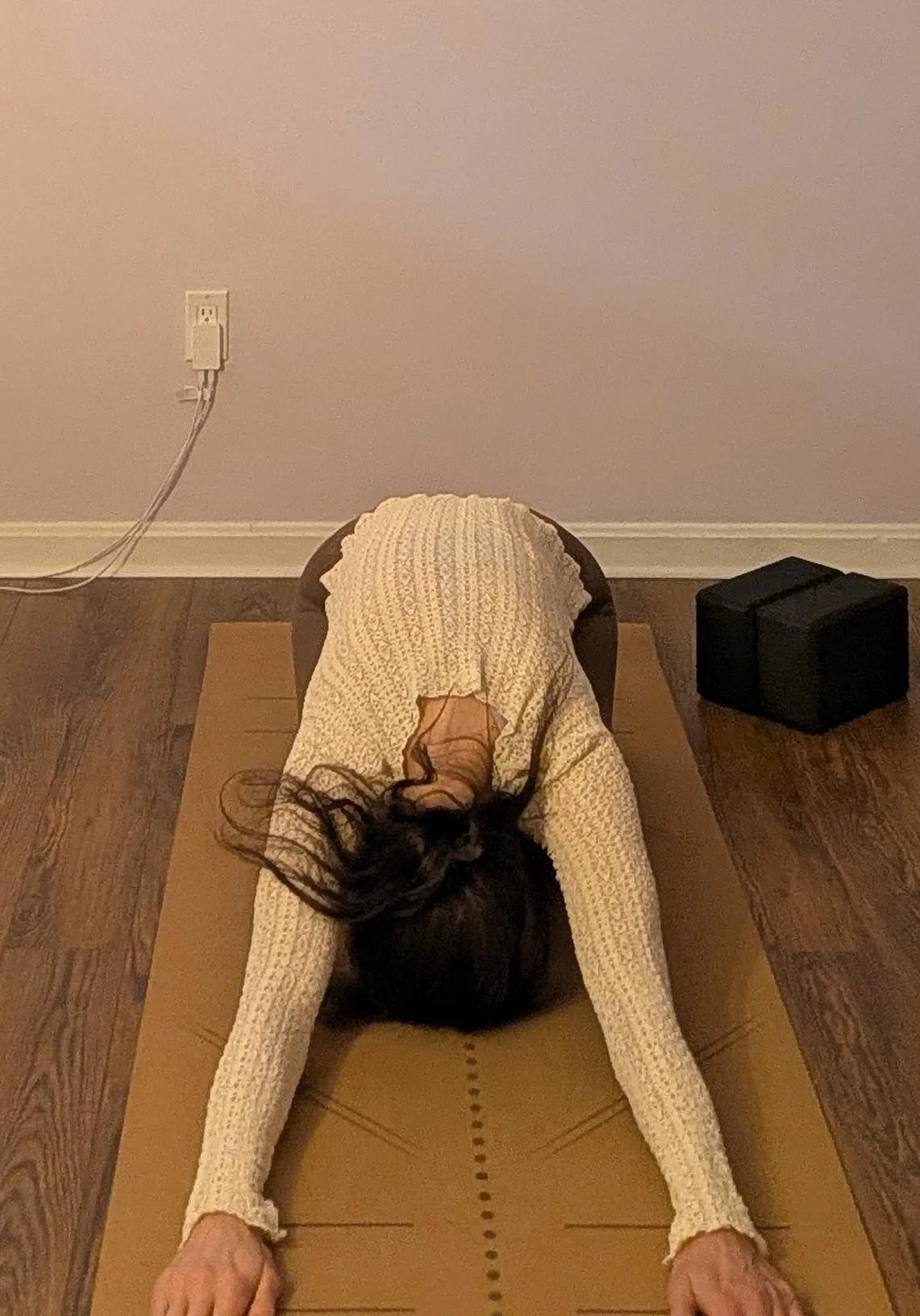
4. Child's Pose
Balasana (bah-LAHS-ah-nah, "child's pose")
A resting shape that asks for nothing more than breath. This is a good place to feel the transition in the body, giving yourself permission to slow down as autumn approaches.
5. Supported Heart Bench / Fish Pose
Matsyasana (mahts-yah-AHS-ah-nah, "fish pose")
Opening the chest and heart space here can feel like meeting the new season with more spaciousness rather than resistance. It's a gentle counter to the forward folding and twisting before it, closing the sequence on an open, receptive note.

A Nature Informed Practice: Threshold Walk to a Color Gradient Altar
This eco therapeutic practice weaves together two small rituals that can be done in fifteen minutes or less, right outside your door.
STEP ONE: GATHER
Walk slowly and gather a handful of items from your yard or a nearby path. Look for a range of colors that hold both summer and fall: green leaves still full of life, and the first golds, rusts, or browns beginning to appear.
STEP TWO: THE THRESHOLD WALK
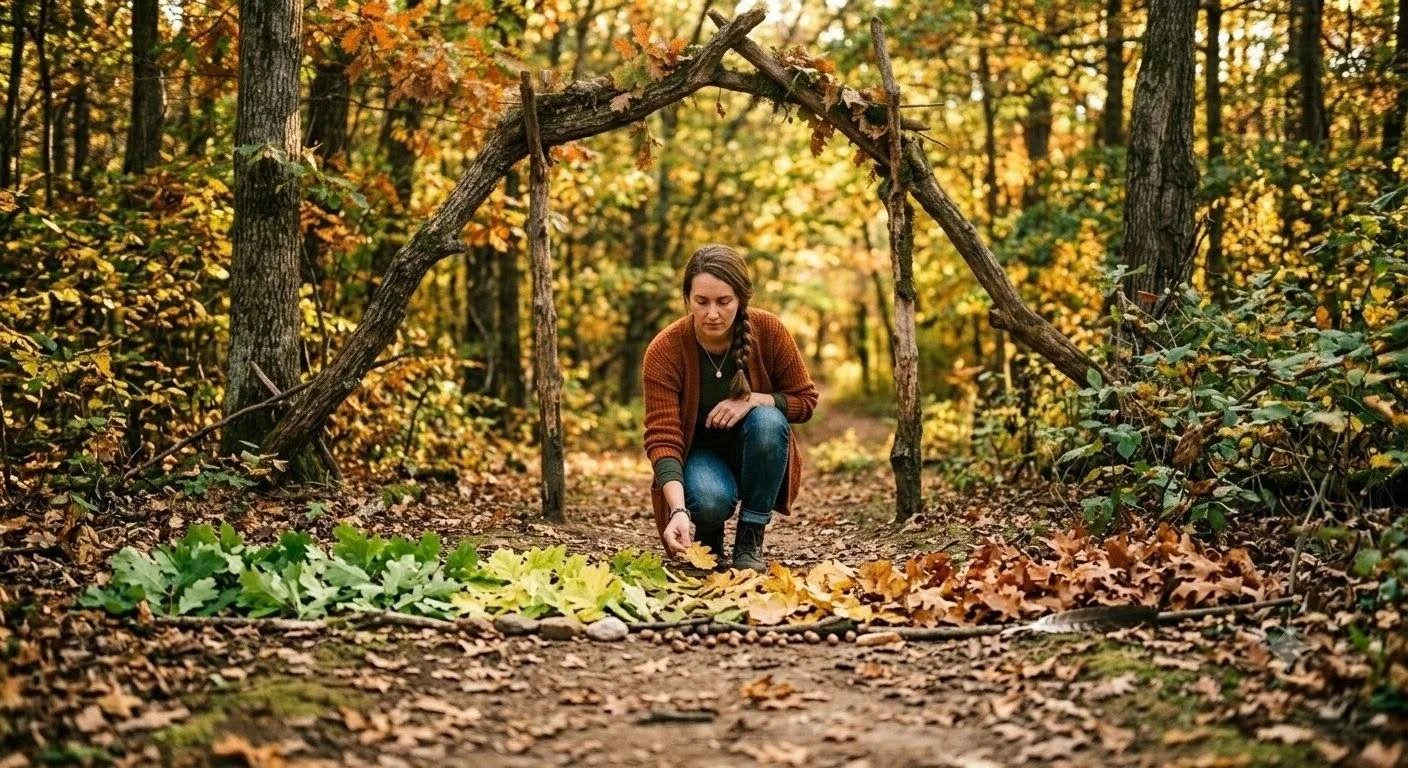
Find two branches, sticks, or a natural opening in your landscape (between two trees, under a low branch) and let it become a doorway. Before you step through it, pause. Silently or aloud, name one thing from summer you're ready to release. Then step through, and name one thing you're welcoming as fall begins.

STEP THREE: BUILD THE COLOR GRADIENT ALTAR
On the other side of your threshold, lay out what you gathered in a line or gentle arc, moving from summer green into early gold and rust. Rather than a circular mandala, this gradient becomes a small visual timeline of the season changing, a piece of the transition itself made visible.
Leave your altar for the wind, the birds, or the next rain, a simple reminder that the seasons move on whether we're ready or not.
Mudra & Mantra for the Transition
Ksepana Mudra
Ksepana Mudra (kshay-PAH-nah, "the gesture of pouring out" or "letting go")
Interlace the fingers of both hands, keeping them crossed. Release the index fingers so their pads press together and extend long, pointing downward. Cross the thumbs, one resting on top of the other. This mudra is traditionally used to pour out or release accumulated heaviness, whether emotional residue, stress, or stagnant energy, which makes it a fitting companion for a summer to fall transition. Hold for a few minutes at most, breathing attention into the exhale, then open the palms upward to receive what comes next.

An Affirmation for the Season
Pair the mudra with this simple phrase, spoken silently or aloud:
"What I have carried, I now pour out. What remains, I carry forward with ease."
Nourishing Recipes for the Season
Two simple ways to bring warmth and grounding to your kitchen as Vata rises this fall.
Grounding Vata Tea
Ingredients
1/3 tsp whole fennel seeds (cools and coordinates digestion)
1/3 tsp whole coriander seeds (clears toxins without increasing heat)
1/4 tsp whole cumin seeds (ignites digestive fire gently)
Pinch of dried ginger root (warms and burns away stagnation)
1 green cardamom pod, gently crushed (counters the dry, light qualities of Vata)
2 cups filtered water
Instructions
Bring 2 cups of water to a boil in a small saucepan.
Add all the seeds, ginger, and crushed cardamom pod.
Turn the heat down to low, cover the pan, and let it simmer for 5 to 7 minutes.
Strain the tea into a mug.
Let it cool slightly to a warm, drinkable temperature. Drink it slowly throughout the morning or late afternoon to ground your energy.

Veggie Rich Autumn Soup
Ingredients
1/2 cup split yellow mung dhal (soaked for 1 to 2 hours and rinsed)
5 cups filtered water
1.5 tbsp SVA Mom's Ghee (or standard organic ghee)
1/2 cup sweet potato or butternut squash, peeled and diced very small
1/2 cup carrots, sliced into thin rounds
1/2 cup zucchini, diced
1/2 cup chard or spinach, chopped
1/4 cup finely chopped flat leaf parsley
1/2 tsp SVA Vata Masala (or equal parts cumin, fennel, and coriander powder)
1/4 tsp organic turmeric powder
1/2 tsp fresh ginger, grated
A pinch of Soma Salt (or pink Himalayan salt)
Fresh cilantro and a squeeze of lime for garnish
Instructions
Bring the water to a boil in a large pot, then add the soaked and rinsed mung dhal. Simmer on medium-low for 15 minutes, skimming off any foam.
Add the hard vegetables (sweet potato and carrots) to the pot. Simmer for another 10 minutes.
Add the soft vegetables (zucchini, parsley and chard / spinach). Cook for 5 to 7 more minutes until all vegetables and dhal are tender.
In a small pan, heat the ghee on low. Add the grated ginger, turmeric, and Vata Masala. Toast gently for 30 seconds until fragrant.
Stir the spiced ghee directly into the soup pot.
Season with Soma Salt. Serve warm, topped with fresh cilantro and a squeeze of lime juice.

Fill your cup (& bowl) first 🍵💕
Jennifer Misterka